I am at peak anesthesia earnings. How much is enough to save, and how do I keep lifestyle creep from eating the best earning years?

Anesthesiology · Established
Peak earning years are short and lifestyle creep is patient. Save a fixed share of the peak before the lifestyle absorbs it.
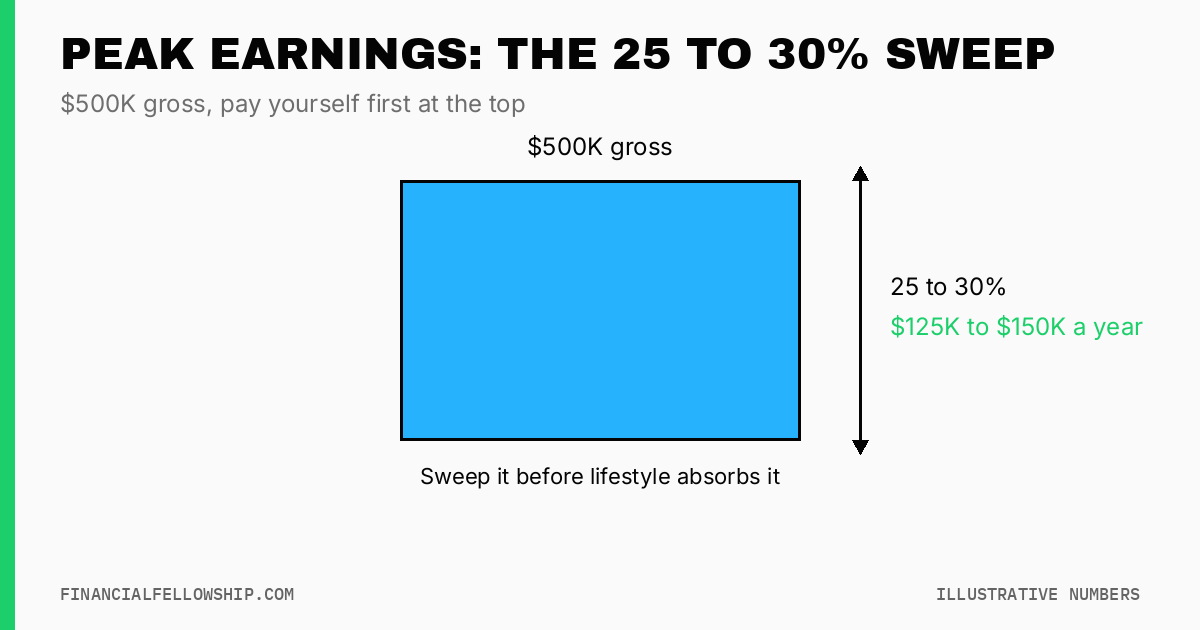
Peak anesthesia earnings are high but not permanent. Call burden, physical wear, and burnout mean many anesthesiologists cannot or do not want to sustain maximum clinical load into their 60s. So the high income years have an expiration date. A savings rate target beats a budget: many high earning physicians aim to save 25 to 30 percent of gross during peak years. Automate the savings before the lifestyle.
Why do peak years expire?
Anesthesia is physical work. Long cases on your feet, in house nights, the accumulated sleep debt of call. At 35, the schedule is a price. At 55, it is a different price. Many anesthesiologists step back from full call, reduce clinical days, or shift to lighter assignments in their 50s, and each step usually comes with a pay cut.
Burnout is the other expiration. The specialty's burnout drivers, loss of autonomy, production pressure, and the grind of call, do not get easier with seniority in every practice model. Planning as if peak income runs to 65 is planning against the base rates of the specialty.
This is not pessimism. It is the reason the peak years matter so much. The money earned now has to fund the years when you earn less, whether that step down is voluntary or not.
Why a savings rate instead of a budget?
Because budgets break at high incomes and savings rates do not. A budget asks you to track spending across dozens of categories. A savings rate asks one question: what percent of gross pay is saved before you touch the rest?
The target many high earning physicians use is 25 to 30 percent of gross during peak years. On $500,000 of gross, that is $125,000 to $150,000 a year saved. That rate funds retirement even if income steps down later, because the compounding does the rest. These are illustrative numbers; the rate is the point, not the dollars.
The rate also self adjusts. Income rises, savings rise. Income falls, the lifestyle already fits the smaller residual. A budget has to be rewritten every time life changes. A rate just runs.
How do you automate it?
Pay yourself first, literally on payday. Max the 401(k): $24,500 in employee deferrals for 2026, plus the employer match, plus the employer profit sharing if the plan allows. Fund the cash balance plan if the group offers one; at peak income it can shelter six figures more. Then sweep the rest to the taxable brokerage account on payday, automatically.
Then live on what remains. That is the whole system. The savings happen before the lifestyle gets a vote.
The accounts in order: 401(k) to the max, cash balance plan if available, backdoor Roth IRA ($7,500 for 2026, if income allows the maneuver), 529s if college funding is in the plan, then taxable. Tax advantaged first, taxable second, spending third.
What does lifestyle creep actually look like?
Its signature moves are the house upgrade, the second home, and private school tuition stacking in the same five year window. Each is defensible alone. The house is an investment. The second home is for the family. The tuition is for the kids. Together, they are three large fixed costs that arrive at peak income and do not leave when income steps down.
The danger is reversibility. A bigger house can be sold, but at transaction costs and life disruption. Private school tuition, once the kids are in, is nearly impossible to reverse without disrupting their lives. The second home is the easiest to unwind and the hardest to admit was a mistake.
None of these are forbidden. The rule is sequencing: automate the 25 to 30 percent first, then buy the life with the residual. Creep is what happens when the order reverses and the lifestyle gets the first vote.
What is the decision rule?
Set the rate. Automate it on payday. Live on the rest. Buy the upgrades from the residual, one at a time, with eyes open about reversibility.
And revisit the rate when life changes: a new mortgage, kids' tuition, a spouse's career change. The rate is a target, not a religion. But every year below target in the peak window is a year you cannot get back, because the peak window is the compounding window.
For an anesthesiologist, the peak years are also the years of maximum call and maximum physical demand. You are earning the most and spending the most of yourself. The savings rate is how you make sure the trade was worth it.
Framework box: the peak years system
| Step | Action |
|---|---|
| 1 | Set the rate: 25 to 30 percent of gross |
| 2 | Max the 401(k) ($24,500 employee for 2026) plus match |
| 3 | Fund the cash balance plan if offered |
| 4 | Backdoor Roth IRA ($7,500 for 2026), then 529s, then taxable |
| 5 | Automate every transfer on payday |
| 6 | Live on the residual; buy upgrades from it, one at a time |
Follow up questions
My private practice group offers a cash balance plan on top of the 401k. How should I think about it?
It is the single largest tax deduction available at peak income, with annual contributions that can reach six figures. The tradeoff is a multi year funding commitment. Max the 401(k) first, then fund it with dollars that would otherwise land in taxable.
I am peak earning with kids approaching college. How should an anesthesiologist fund college without derailing retirement?
Do not fund college at the expense of retirement. Peak earning years are the 529 superfunding window. There are loans for college and no loans for retirement.
Sources
- Internal Revenue Service, 401(k) contribution limits for 2026 (elective deferral $24,500). 401(k) Plans (accessed September 30, 2026)
- Internal Revenue Service, IRA contribution limits for 2026 ($7,500). IRA contribution limits (accessed September 30, 2026)
Published September 30, 2026. Last reviewed September 30, 2026.
Ryan Inman spent 10 years as a financial advisor to physicians, hosted the Financial Residency podcast, and founded Financial Fellowship to teach physicians the money mechanics of a medical career.
Have a money question from your own training or practice? Submit it at financialfellowship.com/submit. Real questions get real answers.
Takeaways
- Saving 25 to 30 percent of peak income builds the freedom the peak is for.
- 2026 limits: $24,500 401(k) deferral plus $7,500 IRA; use the full space.
- Lifestyle creep is the tax you vote for; cap it deliberately during peak years.
- The best earning years fund the decades after them; spend accordingly.
Have a money question we have not answered?
If you have a question about a decision you are about to make, ask it here.
Ask your questionMore reading

I am retiring from clinical practice. Who pays for tail coverage, and how do I time it?
Anesthesiology · Established Retiring does not retire your liability for past cases. Who pays the tail, and when you buy it,

Our group is selling to private equity. As a physician owner, what happens to my proceeds, my taxes, and my job?
Anesthesiology · Established When your group sells to private equity, your proceeds, your taxes, and your job all change at once.

Should I do locums as a bridge toward retirement, or as a mid career reset?
Anesthesiology · Established Locums can be a bridge toward retirement or a mid career reset, but the two uses need different
If you have a question about a decision you are about to make, ask it here
Ask your question