Our group is selling to private equity. As a physician owner, what happens to my proceeds, my taxes, and my job?

Anesthesiology · Established
When your group sells to private equity, your proceeds, your taxes, and your job all change at once. Understand the cash, the rollover, and the employment terms before the vote.
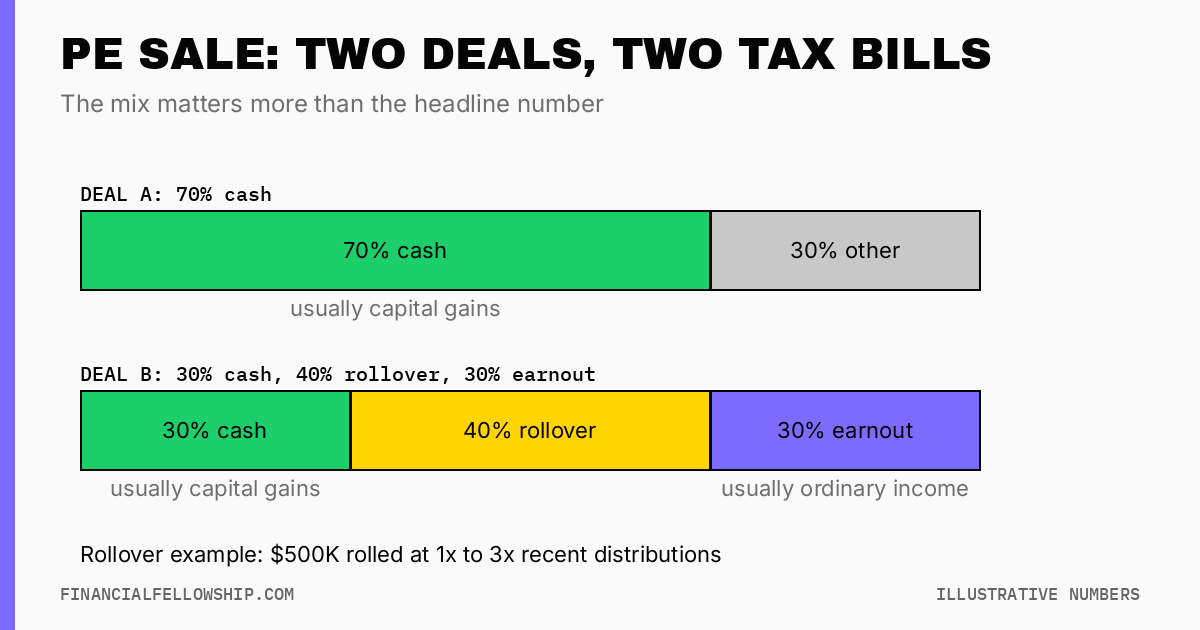
Three things happen at once: your ownership converts to proceeds, your tax bill arrives in pieces, and your job gets repapered. Proceeds usually split into cash at close, rollover equity in the new entity, and earnouts tied to staying. Each piece is taxed differently. Your employment contract, noncompete, and call obligations can all change at the sale. Get independent tax and legal counsel before the deal closes. The group's attorneys represent the group.
How do the proceeds usually split?
Cash at close: the portion paid outright when the deal closes. This is the cleanest piece. It is money in hand, and it is usually taxed as capital gains to the extent it exceeds your basis in the practice, though the exact characterization depends on the deal structure (asset sale vs stock sale) and your entity type.
Rollover equity: a portion of your proceeds that you do not receive as cash but instead roll into ownership of the new, buyer controlled entity. This is the piece to price carefully. It is illiquid, it is valued by the buyer, and it only pays if there is a second sale down the road. Discount it heavily against cash in hand. Rollover equity that the buyer values at $500,000 is not $500,000. It is a lottery ticket priced by the lottery operator.
Earnouts: additional payments tied to staying with the practice, hitting productivity targets, or both. Earnouts are usually taxed as ordinary income when paid, not capital gains. They are also contingent: leave, miss the target, or get terminated, and the earnout may vanish.
The mix matters enormously. A deal that is 70 percent cash is a sale. A deal that is 30 percent cash, 40 percent rollover, and 30 percent earnout is a retention package wearing a sale costume.
What are the tax consequences?
The difference between deal structures can be six figures in tax. That is not an exaggeration. It is the reason for the independent counsel.
Asset sale vs stock sale changes what is capital gains and what is ordinary income. Your entity type (S corp, partnership, LLC taxed as partnership) changes the mechanics further. The allocation of the purchase price among assets, non compete payments, and consulting agreements changes the character of each dollar. Non compete payments to you, for example, are generally ordinary income, not capital gains.
State taxes layer on top. A sale that looks good on federal taxes can be worse in a high tax state, and some physicians consider relocating before a sale closes. That is a decision with its own costs and its own timeline, and it needs to be made with counsel, not at the closing dinner.
Do not rely on the group's tax advisors for your personal tax position. They represent the group. The group's optimal structure and your optimal structure are not the same thing.
What happens to your job?
Your employment contract gets repapered. The physician friendly terms of the old partnership agreement do not automatically survive the sale. Specifically, check:
Your rate: does the compensation formula survive, or does the buyer impose a new one? Buyers buy for margin, and margin comes from somewhere.
Your noncompete: does it assign to the buyer, and did the sale trigger any change of control protections you negotiated? If you did not negotiate them, now is when you feel their absence.
Your call and schedule: the buyer's staffing model may differ from the partnership's. Heavier ratios, more sites, different call.
Your governance: you had a vote. Now you have a manager. That is not a complaint. It is a fact to price.
The earnout ties all of this together: the buyer needs you to stay to earn the earnout, which gives you leverage, but only if you use it before the deal closes. After closing, the leverage is gone.
What do you do before the deal closes?
Get independent tax counsel and independent legal counsel. Not the group's attorneys. Yours.
Understand the proceeds mix and model the after tax outcome of each piece. Price the rollover equity at a heavy discount. Read the new employment agreement as if it were your first contract, because economically it is.
Negotiate what you can while you have leverage: the cash percentage, the earnout triggers (make them achievable and within your control), the noncompete terms under the new entity, and the tail coverage for the transition.
And talk to physicians who have been through a PE sale in anesthesia. The pattern is well established by now. The surprises are rarely surprising to anyone who has seen one before.
What is the decision rule?
Model the after tax proceeds, discount the rollover equity brutally, and read the new employment terms as the real deal. The sale price is not the number in the headline. It is the cash at close, after tax, plus the value of the job you are left with.
For an anesthesiologist owner, the sale is often the largest single financial event of the career. Treat it with the seriousness of that fact: independent counsel, modeled taxes, and no decisions made at the closing dinner.
Follow up questions
My group is offering partnership and a buy in number. How is an anesthesia buy in actually priced, and how do I decide if it is fair?
Price the formula and the audited numbers, compute the payback against the partner premium, and stress test the exit, including the PE sale scenario.
If this group sells in year two, what happens to my rate, my tail, and my covenant?
Negotiate change of control terms before you sign: assignment, tail if the seller dissolves, and whether the noncompete assigns to the buyer.
Sources
No third party transaction or tax source was accessed for this article; the pilot sourcing set did not include one. The proceeds structures described (cash, rollover, earnout) are standard deal mechanics. Tax characterizations are described generally; the article directs readers to independent counsel for their specific situation.
Published September 30, 2026. Last reviewed September 30, 2026.
Ryan Inman spent 10 years as a financial advisor to physicians, hosted the Financial Residency podcast, and founded Financial Fellowship to teach physicians the money mechanics of a medical career.
Have a money question from your own training or practice? Submit it at financialfellowship.com/submit. Real questions get real answers.
Takeaways
- Proceeds usually split into cash at close, rollover equity, and earnout; each is taxed differently.
- Rollover equity keeps you exposed to the same business you just sold.
- Your employment agreement gets rewritten; the clinical job is rarely unchanged.
- Get independent counsel before the vote, not after the announcement.
Have a money question we have not answered?
If you have a question about a decision you are about to make, ask it here.
Ask your questionMore reading

I am retiring from clinical practice. Who pays for tail coverage, and how do I time it?
Anesthesiology · Established Retiring does not retire your liability for past cases. Who pays the tail, and when you buy it,

I am at peak anesthesia earnings. How much is enough to save, and how do I keep lifestyle creep from eating the best earning years?
Anesthesiology · Established Peak earning years are short and lifestyle creep is patient. Save a fixed share of the peak before

Should I do locums as a bridge toward retirement, or as a mid career reset?
Anesthesiology · Established Locums can be a bridge toward retirement or a mid career reset, but the two uses need different
If you have a question about a decision you are about to make, ask it here
Ask your question