Term vs whole life insurance: what's the real answer for physicians?

Physician finance
For most physicians, the answer is term: buy a large, cheap death benefit for the years your family depends on your income, and invest the difference. Whole life is rarely the right tool.
For 99.999% of physicians, term life insurance is the answer. You need life insurance to replace your income during the years people depend on it, and 20 or 30 year level term does that for a small fraction of what whole life costs for the same death benefit. Whole life adds a savings account you can't leave in the early years without losing money. Buy term from a highly rated carrier at the lowest price you can find.
"Insurance is insurance, investments are investments. Never mix the two," says Ryan Inman.
What is life insurance supposed to do for a physician?
Replace your income for the people who'd lose it. If you died tomorrow, your spouse and kids would lose decades of physician earnings, and the mortgage and any student loans would still be there. Life insurance fills that hole until your investments can do it on their own. Once your portfolio could support your family without your paycheck, you don't need the policy anymore.
That's a temporary need, and term insurance is built for temporary needs.
How much coverage do you need?
A fast starting point: take your income times 10, add your debts, and subtract your investments. An attending earning $350,000 with a $500,000 mortgage, $150,000 of student loans, and $400,000 invested would need about $3.5 million plus $650,000 minus $400,000, or $3.75 million. Round up to $4 million and pick a term long enough to get the kids through school and your portfolio to the point it can replace you.
Consider laddering: instead of one $4 million 30 year policy, buy a $2 million 30 year policy plus a $2 million 20 year policy. It saves premium because the shorter policy costs less per year, and it matches your real timeline. Early on you need maximum coverage with young kids and a big mortgage. Twenty years later the kids are grown, the mortgage is smaller, and your portfolio does more of the work. Laddering lets policies expire as your net worth rises to the point you can self insure.
Why does whole life cost so much more?
Because you're buying two things at once. Whole life combines a death benefit that lasts your whole life with a cash value account, and the premium stays level for life. Dividends are not guaranteed. The first several years of premium go heavily toward the agent's commission and the insurer's costs, so the cash value you could walk away with is usually far below what you've paid in for a long stretch.
Whole life is designed to be sold, not bought. The people selling it aren't bad people. They have a compensation model that pays far more on whole life than on term, and that shapes what gets pitched to a new attending at a conference or over a free lunch.
What does the cost difference look like?
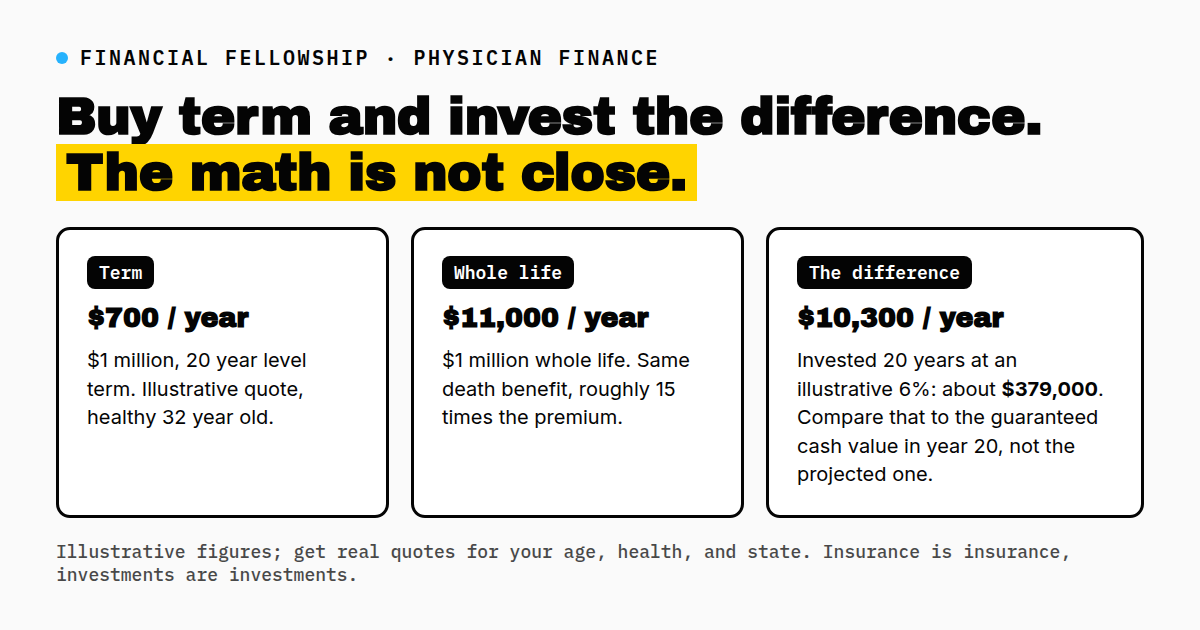
Get real quotes for your age, health, and state, because prices vary a lot. For illustration only, say a healthy 32 year old physician is quoted $700 a year for $1 million of 20 year term and $11,000 a year for $1 million of whole life. The difference is $10,300 a year.
Invest that $10,300 every year for 20 years at an illustrative 6% return and you'd have about $379,000. Now ask the whole life agent for the policy illustration and look at the guaranteed cash value in year 20, not the projected one. That comparison, guaranteed cash value against the invested difference, is the honest test.
Is term from a whole life company a bad deal?
Not automatically. A term policy from a mutual company that sells whole life can be a perfectly good policy. The issue is price and pressure. Some of these carriers price term higher than the market, and some agents sell term as a stepping stone toward converting you later. Compare their quote with quotes from several other highly rated carriers. If it's competitive, buy it.
Where should you buy term life insurance?
From an independent broker or quote service that shows you several carriers side by side, not an agent who represents one company. Check that the carrier has a strong financial strength rating from an independent rating agency. Look for a level premium for the whole term. Skip the conversion rider. It sounds like free optionality, the right to convert to permanent insurance later without new underwriting, but in practice it is a sales tool. Agents use the conversion window as the pitch to move you into whole life years later, which is the product you already decided against. The rider adds cost to your term premium, small but real, and for 99.99% of physicians it never pays off. If your situation ever became one of the rare exceptions that needs permanent coverage, you would buy it then, not through a rider.
I already bought whole life. What now?
Start with the free look period. Most states require a window after delivery, often 10 days or longer depending on the state and the policy, when you can cancel for a full refund. Check the policy's first pages for the exact number of days.
Past that window, ignore what you've already paid. That money is gone either way. Request an in force illustration and look at what next year's premium buys you in guaranteed cash value. Then compare four options: keep it, convert it to a reduced paid up policy, move the cash value into a low cost annuity through a section 1035 exchange to preserve your cost basis (26 U.S.C. 1035), or surrender it. If you surrender for more than you've paid in premiums, the gain is taxable as ordinary income. A loss on a personal policy generally isn't deductible.
Never cancel a policy until the replacement term policy is approved and in force.
Does permanent insurance ever make sense?
Extremely rare, but yes for very few reasons. A household whose estate will clearly exceed the federal estate tax exemption, $15 million per person for 2026 (IRS, Estate Tax), may use permanent coverage to pay the tax bill. A dependent with a lifelong disability can create a permanent need. Business buy sell agreements sometimes call for it. These are planning decisions for an estate attorney and a fee only planner, not something to buy from a pitch. If this isn't your situation, then the answer is term insurance.
Framework box: which policy fits?
| Your situation | Leaning |
|---|---|
| Spouse, kids, or debt depend on your income | Term, sized with income times 10 plus debts minus investments |
| No dependents and no cosigned debt | Possibly no life insurance yet |
| Already bought whole life, inside the free look window | Cancel for a refund after term is in force |
| Already bought whole life, past the free look window | Get an in force illustration and compare options |
| Estate clearly above the federal exemption, or a lifelong dependent (extremely rare) | Talk to an estate attorney and a fee only financial planner before any decision regarding insurance |
Follow up questions
How long should my term policy be?
Long enough to cover the years until your youngest is independent and your investments could replace your income. For many new attendings that's 20 to 30 years. Some split coverage into two policies of different lengths.
Does a stay at home spouse need life insurance?
Often yes. Replacing childcare and household work costs real money, and that's the number to insure.
Should I buy disability insurance before life insurance?
For most physicians, disability comes first. A disability stops your income while you're still alive to need it, so it gets addressed before life insurance. Both matter once someone depends on you.
Sources
- 26 U.S.C. 1035, Certain exchanges of insurance policies (Cornell Legal Information Institute). (accessed September 30, 2026)
- Internal Revenue Service, Estate Tax. (accessed September 30, 2026)
Published September 30, 2026. Last reviewed September 30, 2026.
Ryan Inman spent 10 years as a financial advisor to physicians, hosted the Financial Residency podcast, and founded Financial Fellowship to teach physicians the money mechanics of a medical career.
Have a money question from your own training or practice? Submit it at financialfellowship.com/submit. Real questions get real answers.
Takeaways
- Term covers the need: income replacement while dependents rely on your earnings.
- Buy 10 to 15 times income in level term for 20 to 30 years as a starting frame.
- Whole life mixes insurance with investing and does both expensively.
- Illustrations are not guarantees; illustrated returns assume the best case.
- Revisit coverage as net worth grows; the need shrinks as assets replace income.
Have a money question we have not answered?
If you have a question about a decision you are about to make, ask it here.
Ask your questionMore reading

How do I compare a locums rate to my W2 salary with benefits?
Compare per day worked, not per year: price every W2 benefit in dollars, then divide by days worked. A locums rate usually needs to beat the W2 daily figure by 15 to 35 percent to break even.

What is tail coverage, and who pays for it when I leave?
Tail coverage keeps a claims made malpractice policy covering you for claims filed after you leave. Your contract decides who pays, and it is usually priced as a multiple of your annual premium.

I bought whole life insurance after residency. Should I keep it or surrender it?
Ignore what you have already paid. Get an in force illustration, price the return on future premiums from today's surrender value, and exit once replacement term coverage is in force if that return is low.
If you have a question about a decision you are about to make, ask it here
Ask your question