Should I use a Roth or traditional 401k in the year I become an attending?

Physician finance
The year you go from resident to attending, your income is split across two brackets. That split year is often the best Roth opportunity of your career.
Your marginal tax bracket for the whole calendar year decides it, no matter which paycheck the money comes from. A July start usually means half a year of training pay plus half a year of attending pay, which often lands a single physician in the 24% bracket and a married one in the 22% bracket. That's typically the lowest rate you'll see as an attending, so Roth contributions cost less that year than in any year after.
How does the IRS tax contributions in a transition year?
Every Roth dollar you contribute in a year is taxed at your marginal rate for that year. Every traditional dollar saves tax at that same rate. The IRS doesn't care that some contributions came out of a PGY 5 paycheck and some out of an attending paycheck. It adds up your total income for January through December and taxes it once.
So a resident who kept Roth contributions going through June didn't pay a resident tax rate on them. They pay the transition year rate, whatever it turns out to be.
For a physician, the transition year is a one time window. Every full attending year after it will likely sit one or two brackets higher.
What bracket does a transition year usually land in?
Take a single physician finishing training in June 2026. Illustrative numbers:
- January through June as a PGY 5 at $72,000 a year: $36,000
- July through December as an attending at $320,000 a year: $160,000
- Total W2 income for 2026: $196,000
Subtract the 2026 standard deduction of $16,100 and a full $24,500 traditional deferral, and taxable income is $155,400. In 2026, the single 24% bracket runs from $105,700 to $201,775 (IRS Rev. Proc. 2025-32, 2025). Every dollar of that $24,500 deferral sits inside the 24% bracket, Roth or traditional.
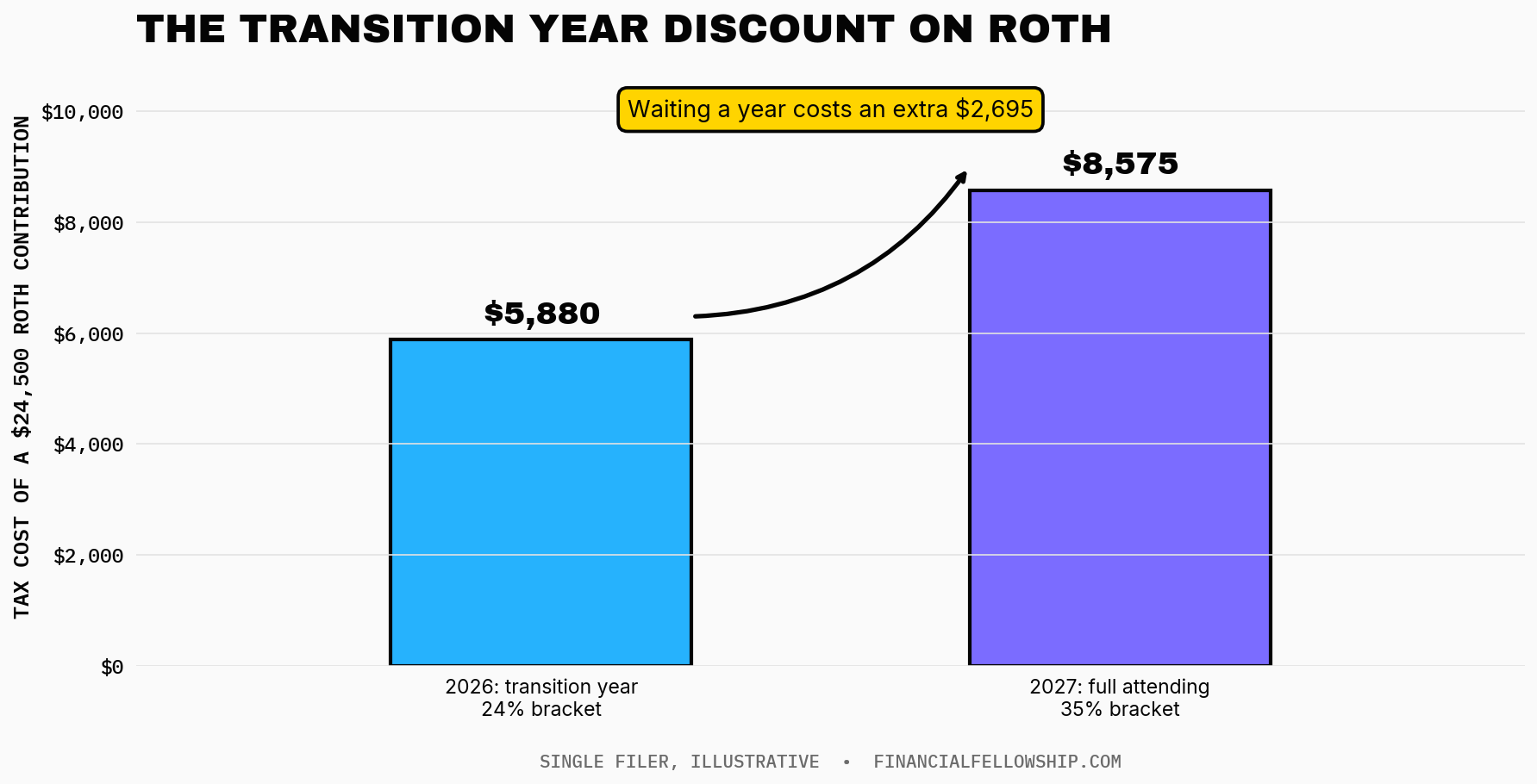
- All traditional saves $24,500 times 24%, or $5,880 of federal tax in 2026.
- All Roth costs that $5,880 now and comes out tax free in retirement.
Now run 2027 as a full attending year at $320,000. Taxable income after the same deferral and deduction is about $279,400, which is in the 35% bracket (IRS Rev. Proc. 2025-32, 2025, before 2027 inflation adjustments). A traditional deferral that year saves about $8,575. A Roth contribution costs the same.
If you want some Roth money in your career mix, and most physicians should think about it, the transition year prices it at 24%. The next year prices it at 35%.
Married with a spouse who doesn't earn much, the same $196,000 lands in the 22% bracket, since the 2026 joint 22% bracket runs to $211,400 (IRS Rev. Proc. 2025-32, 2025).
So should I switch to Roth, traditional, or split it?
Compare this year's marginal rate to the rate you expect to pay on withdrawals in retirement. Nobody knows that future rate, which is why a split is a reasonable answer. Two rules of thumb cover most transition years:
- At 22% or 24% this year, Roth or a heavy Roth split usually makes sense, because many physicians expect to be at or near those rates in retirement.
- At 32% or higher, traditional usually wins, because you're saving tax at a rate you're less likely to face later.
Two exceptions can flip the lean: if you're pursuing PSLF, traditional contributions lower the income your loan payments are based on, and a move between very different state tax rates changes the math. Both are covered in the follow up questions below.
Your employer match goes in as pretax in most plans regardless of your choice, so even an all Roth election leaves you with some traditional money.
What's the mistake people make in the transition year?
Going over the deferral limit. The $24,500 limit for 2026 is per person, across every 401(k) and 403(b) you contribute to that year (IRS, 2025). Your residency 403(b) and your new employer's 401(k) don't talk to each other.
If you deferred $12,000 as a resident, you have $12,500 left for the attending plan. Many new attendings set their new election to the max and blow past it. An excess deferral has to be taken out by April 15 of the following year, or the same dollars get taxed twice (IRS Publication 525, 2026). Tell your new HR department the dollar amount you can still contribute, and set the election to that.
A governmental 457(b) has its own separate limit and doesn't count against the $24,500. Employer contributions don't count against it either.
Framework box: picking your transition year election
| Step | What to check |
|---|---|
| 1 | Add up total calendar year W2 income from both jobs |
| 2 | Subtract your deductions and find your 2026 marginal bracket |
| 3 | 22% or 24%: lean Roth or a heavy Roth split |
| 4 | 32% or higher: lean traditional |
| 5 | Subtract what you already deferred as a resident from $24,500 |
| 6 | Give your new employer that remaining dollar amount, not a percentage |
Follow up questions
I'm going for PSLF. Does that change the answer?
It can. Income driven repayment is based on adjusted gross income, and traditional contributions lower it while Roth contributions don't. For someone expecting forgiveness, the lower payment from traditional contributions can be worth more than the Roth tax savings. Run both.
Can I still contribute to a Roth IRA this year?
Maybe. Your transition year income might be under the Roth IRA limit even if a full attending year won't be. If you went over, the backdoor Roth question covers what to do.
Does my state tax change the answer?
Yes, if you're moving from a no income tax state to a high tax state or the reverse. Add the state marginal rate to the federal rate for both this year and your expected retirement state.
What about catch up contributions under SECURE 2.0?
Starting in 2026, higher earners have to make 401(k) catch up contributions as Roth. If you're 50 or older and your prior year wages were above the threshold, your catch up dollars go to Roth automatically. It doesn't change the transition year math above, but it does change where those extra dollars land.
Sources
- Internal Revenue Service, Rev. Proc. 2025-32, 2026 inflation adjustments (tax brackets and standard deduction). Rev. Proc. 2025-32 (accessed September 30, 2026)
- Internal Revenue Service, Publication 525, Taxable and Nontaxable Income (excess elective deferrals). Publication 525 (accessed September 30, 2026)
Published September 30, 2026. Last reviewed September 30, 2026.
Ryan Inman spent 10 years as a financial advisor to physicians, hosted the Financial Residency podcast, and founded Financial Fellowship to teach physicians the money mechanics of a medical career.
Have a money question from your own training or practice? Submit it at financialfellowship.com/submit. Real questions get real answers.
Takeaways
- A transition year blends resident months with attending months, landing you in a middle bracket.
- Roth usually wins in the transition year because your lifetime tax rate will likely be higher later.
- Run the actual numbers: PGY salary months plus attending months, not a full year of either.
- Exceptions exist: big deductions or PSLF payment math can flip the answer.
- New for 2026: higher earners must make 401(k) catch up contributions as Roth under SECURE 2.0.
Have a money question we have not answered?
If you have a question about a decision you are about to make, ask it here.
Ask your questionMore reading

How do I compare a locums rate to my W2 salary with benefits?
Compare per day worked, not per year: price every W2 benefit in dollars, then divide by days worked. A locums rate usually needs to beat the W2 daily figure by 15 to 35 percent to break even.

What is tail coverage, and who pays for it when I leave?
Tail coverage keeps a claims made malpractice policy covering you for claims filed after you leave. Your contract decides who pays, and it is usually priced as a multiple of your annual premium.

I bought whole life insurance after residency. Should I keep it or surrender it?
Ignore what you have already paid. Get an in force illustration, price the return on future premiums from today's surrender value, and exit once replacement term coverage is in force if that return is low.
If you have a question about a decision you are about to make, ask it here
Ask your question