Should I do the mega backdoor Roth, and how do I check if my plan allows it?

Physician finance
The mega backdoor Roth lets you get much more than $24,500 a year into Roth through your 401(k). It only works if your plan allows it, so here is how to check and what can go wrong.
The mega backdoor Roth is worth doing if your 401(k) or 403(b) accepts after tax contributions and lets you move them into Roth quickly, and you've already funded your regular deferral, employer match, backdoor Roth IRA, HSA, and a governmental 457(b) if you have one. To check, read your summary plan description for two features: after tax (non Roth) contributions, and either an in plan Roth conversion or an in service withdrawal of after tax money.
What is the mega backdoor Roth?
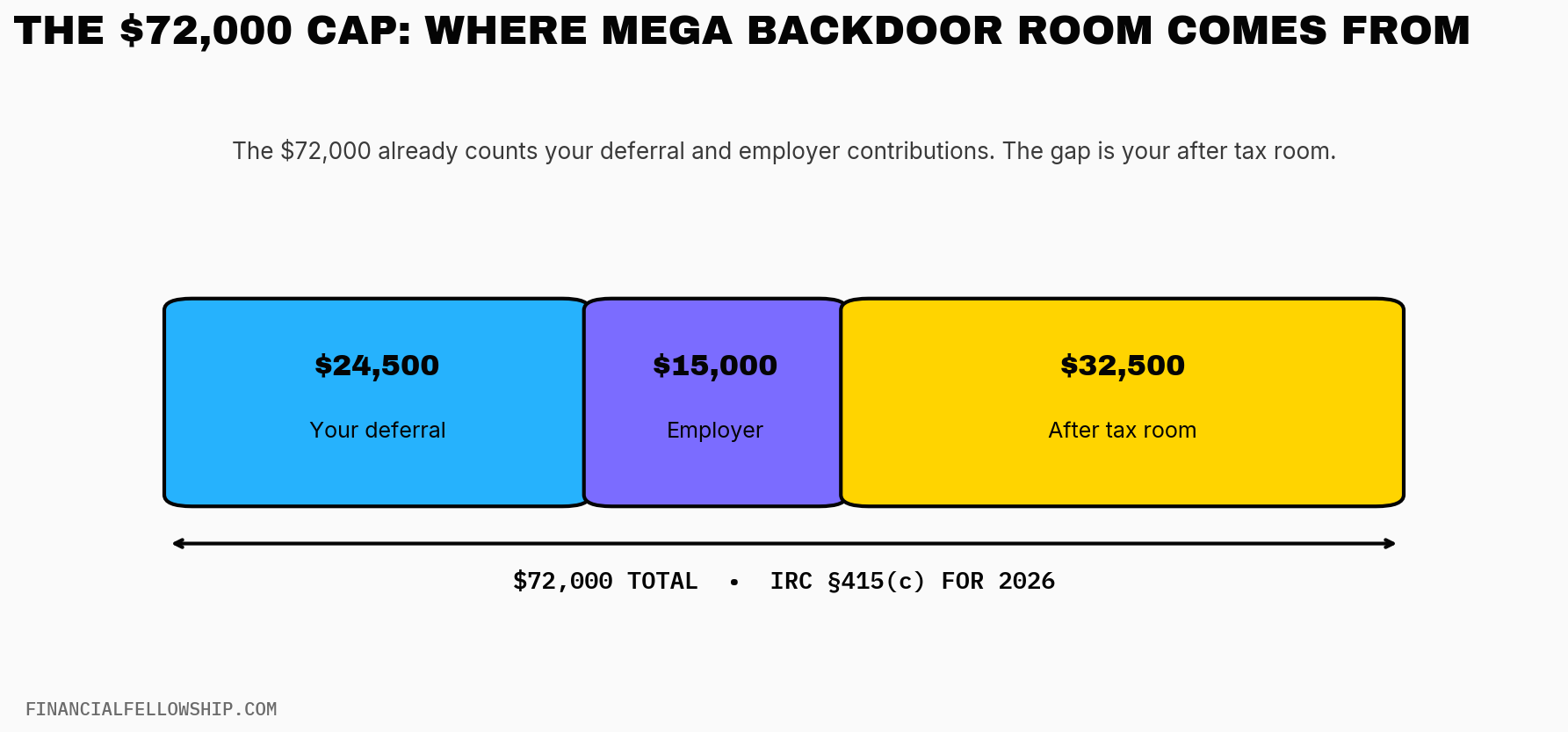
It's a way to put money into Roth well beyond the normal deferral limit. Your workplace plan has two separate caps. The first is your own elective deferral, $24,500 for 2026 (IRS Notice 2025 67, 2025). The second is the total of everything that goes into your account in a year, from you and your employer combined, which is $72,000 for 2026 under section 415(c) (IRS Notice 2025 67, 2025).
The gap between those two numbers can be filled with after tax contributions, if your plan allows them. Those dollars go in with no deduction. Then you convert them to Roth, either inside the plan or by rolling them out to a Roth IRA. Because you already paid tax on the contribution, the conversion only taxes whatever earnings built up before you converted. Convert fast and that tax bill is close to zero.
How much room do you have in 2026?
Less than most people assume, because the $72,000 is the total, not an add on. A common version of this question is "my 403(b) and 457 are maxed, can I put another $69,000 in the mega backdoor?" The answer is no. The $69,000 was the 2024 total limit, and it already counted your own deferral and your employer's contributions.
The math for 2026 is:
$72,000 minus your deferral minus your employer's contributions = your after tax room.
Two things work in your favor. Your 457(b) has its own separate limit and doesn't count against the $72,000 (IRS, IRC 457(b) Deferred Compensation Plans). And in a dual physician household, each spouse has their own plan and their own $72,000 limit, so you run this math twice.
What does it look like with real numbers?
Take a dual physician household. Spouse A is at a hospital system whose 403(b) allows after tax contributions and in plan Roth conversions. Spouse B's plan doesn't offer after tax contributions at all.
Spouse A defers $24,500 and the employer puts in $15,000. That leaves $72,000 minus $24,500 minus $15,000, or $32,500 of after tax room. Spouse B has zero, no matter how much they earn.
Now say Spouse A puts $32,500 a year into the mega backdoor for 15 years and earns 7% a year. That's an illustrative return, not a promise. The account grows to about $816,700, of which $487,500 is contributions and $329,200 is growth. Held in Roth and withdrawn under the qualified distribution rules, none of that growth is taxed.
Put the same $32,500 a year into a taxable brokerage account instead and sell at the end. At the 20% long term capital gains rate plus the 3.8% net investment income tax, the $329,200 of growth costs about $78,300 in federal tax. That's before counting the tax you'd pay every year on dividends along the way. The Roth side avoids both.
For a physician household already maxing the standard accounts, that's the whole case. It's the last tax advantaged bucket available on a W2 before everything else lands in taxable.
How do I check if my plan allows it?
Get your summary plan description from HR or your plan's website and search it for these terms.
- "After tax contributions" or "voluntary after tax." This has to be separate from Roth deferrals. Roth 401(k) or Roth 403(b) contributions count against the $24,500, not the extra room.
- "In plan Roth conversion," "in plan Roth rollover," or "in service withdrawal" of after tax money. Without one of these, your after tax dollars sit there and their earnings grow as pretax money you'll pay ordinary income tax on later.
- Any cap on after tax contributions as a percentage of pay. Some plans limit it to something like 10% of salary, which can shrink your room well below the 415(c) math.
- How often conversions can happen. Automatic conversion on every paycheck is ideal. Once a quarter works. Once a year leaves more earnings exposed to tax.
If the document is vague, call the plan administrator and ask three questions word for word. Does the plan accept after tax contributions that are separate from Roth deferrals? Can I convert them to Roth in plan, or withdraw them while still employed? Were after tax contributions refunded to highly compensated employees after last year's nondiscrimination testing?
What can go wrong?
The biggest risk is a refund from nondiscrimination testing. After tax contributions and employer matches go through the ACP test, which compares what highly compensated employees contribute against everyone else (IRS, 401(k) Plan Fix It Guide on ADP and ACP testing). At physician income, you're almost certainly highly compensated. If lower paid staff don't contribute much, the plan can fail and hand some of your after tax money back. That's why the last question on that phone call is worth asking.
The second risk is liquidity. Money in a Roth inside a workplace plan is harder to reach than money in a brokerage account. If you're still building a house down payment or a practice buy in fund, those goals come before this one.
Framework box: where the mega backdoor fits
| Order | Account | 2026 figure |
|---|---|---|
| 1 | 401(k) or 403(b) up to the full employer match | Plan specific |
| 2 | One month of reserves, sized at the new lifestyle | Your number |
| 3 | Backdoor Roth IRA, each spouse | $7,500 each |
| 4 | HSA, if you're on an eligible high deductible plan | $4,400 self only, $8,750 family |
| 5 | Full elective deferral | $24,500 |
| 6 | Governmental 457(b) (a nongovernmental 457(b) needs its own look) | $24,500 |
| 7 | Mega backdoor Roth | $72,000 minus deferral minus employer money |
| 8 | Taxable brokerage | No limit |
Around these account steps, the waterfall runs in full: cards to zero and coverage come before the Roth, debt above 7 percent waits until the accounts are maxed and the reserve holds three months, and the reserve gets finished at six months of expenses on W2 income or twelve months on 1099 income before taxable investing.
Sources for figures: IRS Notice 2025 67 (2025) and IRS Rev. Proc. 2025 19 (2025).
Follow up questions
Does the mega backdoor Roth mess up my backdoor Roth IRA?
No. The pro rata rule that trips up backdoor Roth IRAs only looks at IRA balances on December 31. Money inside your 401(k) or 403(b) isn't part of that calculation.
What happens to unconverted after tax money if I leave the job?
You can split it when you roll out. IRS Notice 2014 54 (2014) allows the after tax basis to go to a Roth IRA and the pretax earnings to go to a traditional IRA or another plan.
Is it worth it if I'll only be at this job for two years?
Usually yes, as long as the plan converts quickly. The Roth money is yours and rolls to a Roth IRA when you leave.
What about catch up contributions under SECURE 2.0?
Starting in 2026, higher earners have to make 401(k) catch up contributions as Roth. If you're 50 or older and your prior year wages were above the threshold, those dollars land in Roth automatically. It doesn't change the mega backdoor math, but it does change where your catch up dollars land.
Sources
- Internal Revenue Service, Notice 2025 67, 2026 limitations for retirement plans. Notice 2025 67 (accessed September 30, 2026)
- Internal Revenue Service, Rev. Proc. 2025 19, 2026 HSA contribution limits. Rev. Proc. 2025 19 (accessed September 30, 2026)
- Internal Revenue Service, Notice 2014 54, allocation of after tax amounts to rollovers. Notice 2014 54 (accessed September 30, 2026)
- Internal Revenue Service, IRC 457(b) Deferred Compensation Plans. IRC 457(b) Deferred Compensation Plans (accessed September 30, 2026)
- Internal Revenue Service, 401(k) Plan Fix It Guide, ADP and ACP nondiscrimination tests. 401(k) Plan Fix It Guide (accessed September 30, 2026)
Published September 30, 2026. Last reviewed September 30, 2026.
Ryan Inman spent 10 years as a financial advisor to physicians, hosted the Financial Residency podcast, and founded Financial Fellowship to teach physicians the money mechanics of a medical career.
Have a money question from your own training or practice? Submit it at financialfellowship.com/submit. Real questions get real answers.
Takeaways
- Worth doing after you have funded your deferral, match, backdoor Roth IRA, HSA, and a governmental 457(b) if you have one.
- Your plan must allow after tax contributions AND quick Roth conversions; check the summary plan description.
- 2026 total additions cap is $72,000 per person, which sets your mega backdoor room.
- Watch for plan caps on after tax percentages and limits on conversion frequency.
- New for 2026: higher earners must make 401(k) catch up contributions as Roth under SECURE 2.0.
Have a money question we have not answered?
If you have a question about a decision you are about to make, ask it here.
Ask your questionMore reading

How do I compare a locums rate to my W2 salary with benefits?
Compare per day worked, not per year: price every W2 benefit in dollars, then divide by days worked. A locums rate usually needs to beat the W2 daily figure by 15 to 35 percent to break even.

What is tail coverage, and who pays for it when I leave?
Tail coverage keeps a claims made malpractice policy covering you for claims filed after you leave. Your contract decides who pays, and it is usually priced as a multiple of your annual premium.

I bought whole life insurance after residency. Should I keep it or surrender it?
Ignore what you have already paid. Get an in force illustration, price the return on future premiums from today's surrender value, and exit once replacement term coverage is in force if that return is low.
If you have a question about a decision you are about to make, ask it here
Ask your question