Backdoor Roth IRA: how does it actually work, step by step?

Physician finance
A backdoor Roth IRA is two legal moves: a nondeductible traditional IRA contribution, then a conversion to Roth. Here is how it works, step by step, plus the pro rata rule that trips up physicians.
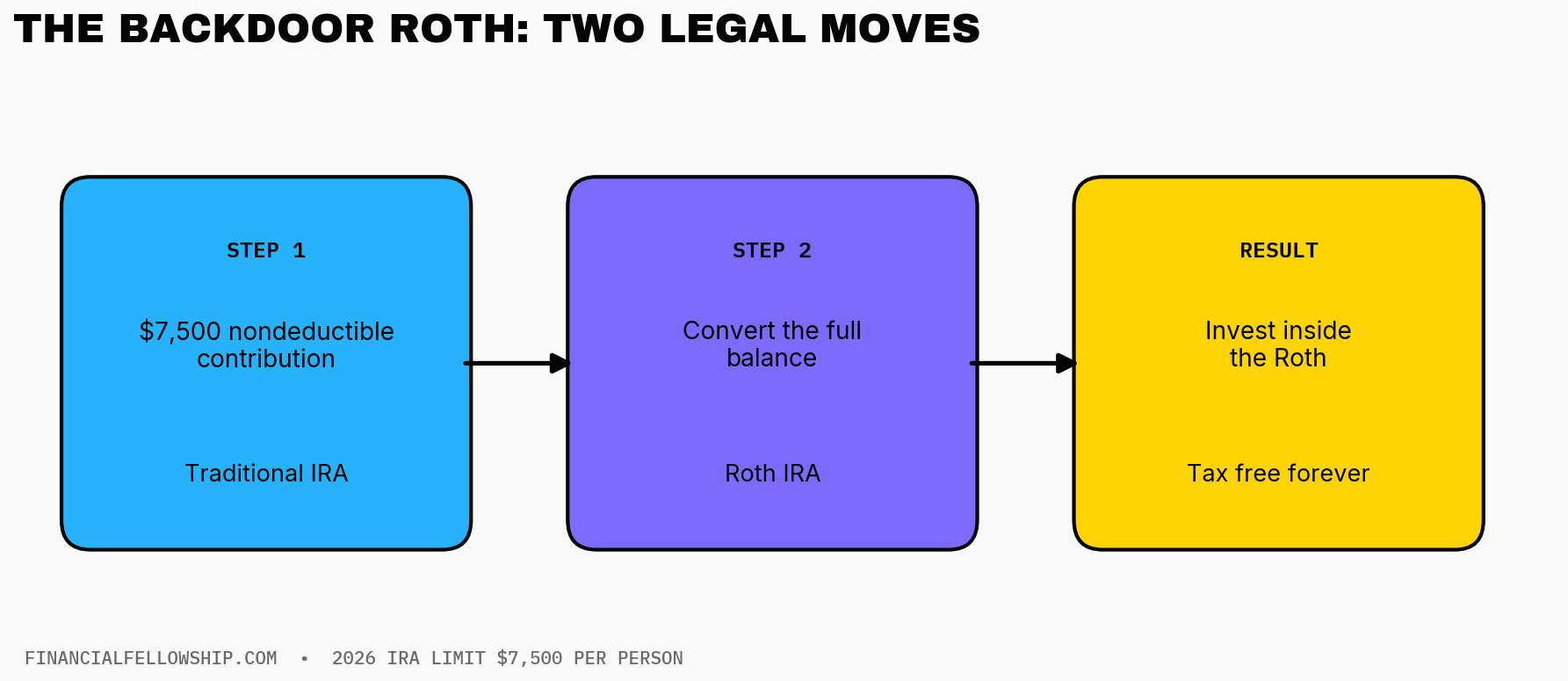
A backdoor Roth IRA is two legal moves. You make a nondeductible contribution to a traditional IRA, then convert that money to a Roth IRA. Physicians use it because their income is above the limit for contributing to a Roth directly. For 2026 the IRA contribution limit is $7,500 (IRS, 2025). The step people miss is clearing out any pretax IRA money first, because of the pro rata rule.
Why can't I just contribute to a Roth IRA?
Direct Roth IRA contributions phase out at higher incomes. For 2026 the phase out runs from $153,000 to $168,000 of modified adjusted gross income for single filers and $242,000 to $252,000 for married couples filing jointly (IRS, 2025). Most attendings are well past it.
Traditional IRA contributions have no income limit. Conversions to Roth have no income limit either, since 2010. Put those two facts together and you have the backdoor. Nothing about it is hidden or aggressive. The maneuver was described in the conference report for the 2017 Tax Cuts and Jobs Act, and it has been widely used and written about ever since.
For a physician, this is $7,500 a year per person that grows and comes out tax free in retirement. A married couple can each do one, including a spouse without earned income, through a spousal IRA.
What are the steps?
- Check for pretax IRA money. Look at every traditional IRA, rollover IRA, SEP IRA, and SIMPLE IRA in your name. If the total will be above zero on December 31 of the year you convert, stop and fix that first. (More on this below.)
- Open a traditional IRA and a Roth IRA at the same brokerage. Same custodian makes the conversion a few clicks.
- Contribute $7,500 to the traditional IRA. This is a nondeductible contribution. Leave it in the settlement fund or money market. Don't invest it yet. You can make 2026 contributions until the tax filing deadline in April 2027.
- Convert the full balance to the Roth IRA. Most people wait until the deposit settles, a few days. If a few dollars of interest post before you convert, convert those too. That small amount is taxable, and that's fine.
- Invest the money inside the Roth IRA. This is where people slip. The money sits in cash in the Roth for years because nobody picked a fund.
- File Form 8606 with your tax return. Part I reports the nondeductible contribution. Part II reports the conversion. Each spouse files their own. Your brokerage will send a Form 1099 R for the conversion, and your tax software or preparer needs Form 8606 to show it wasn't taxable.
What is the pro rata rule, and how does it wreck a backdoor Roth?
The pro rata rule says the IRS treats all your traditional, rollover, SEP, and SIMPLE IRAs as one account when you convert. You can't choose to convert only the after tax dollars. Each conversion is taxed in proportion to the pretax money across all of them, measured on December 31 (IRS Form 8606 instructions).
Take a new attending with a $50,000 rollover IRA from an old 403(b). They contribute $7,500 nondeductible and convert $7,500.
- Total IRA balance: $57,500
- After tax share: $7,500 of $57,500, about 13 percent
- Taxable portion of the $7,500 conversion: about $6,520
At a 35 percent federal bracket, that's roughly $2,280 of federal tax on a move that was supposed to cost nothing.
The usual fix is to roll the pretax IRA money into your current employer's 401(k) or 403(b) before December 31, if the plan accepts incoming rollovers. Employer plan balances don't count in the pro rata math. Call the plan administrator and ask directly whether they accept roll ins of IRA money. Another fix is converting the whole pretax balance and paying the tax, which can make sense in a low income year like the last year of fellowship.
Is there a waiting period between contributing and converting?
No IRS rule sets a waiting period. Some people wait a month or longer out of caution about the step transaction doctrine. Given the 2017 conference report language, most physicians convert once the contribution settles. If this question worries you, ask your own tax professional.
Can I take the money out early?
Your contributions can generally come out anytime without tax. Converted amounts carry their own five year clock for the 10 percent penalty if you're under 59 and a half, and earnings need both age 59 and a half and five years to come out tax free. Treat the backdoor Roth as retirement money.
Framework box: backdoor Roth checklist for 2026
| Step | Done when |
|---|---|
| Pretax IRA balance on December 31 | $0, or rolled into an employer plan |
| Traditional IRA contribution | $7,500 deposited, left in cash |
| Conversion | Full balance moved to Roth IRA |
| Roth investment | Money is in a fund, not cash |
| Tax filing | Form 8606 filed for each spouse |
Follow up questions
Should I do the backdoor Roth before or after maxing my 401(k)?
For most attendings the employer plan comes first because the limit is larger and there may be a match. The backdoor Roth is the next layer once the employer plan is covered.
What if I already did a backdoor Roth and had a rollover IRA?
The conversion was partly taxable. Form 8606 will show it. If it hasn't been filed correctly, a tax professional can amend the return.
Sources
- Internal Revenue Service, "401(k) limit increases to $24,500 for 2026, IRA limit increases to $7,500" (November 2025). 2026 IRA and 401(k) limitscreases-to-7500 (accessed September 30, 2026)
- Internal Revenue Service, Instructions for Form 8606, Nondeductible IRAs. Instructions for Form 8606 (accessed September 30, 2026)
- Internal Revenue Service, Publication 590 A, Contributions to Individual Retirement Arrangements. Publication 590-A (accessed September 30, 2026)
Published September 30, 2026. Last reviewed September 30, 2026.
Ryan Inman spent 10 years as a financial advisor to physicians, hosted the Financial Residency podcast, and founded Financial Fellowship to teach physicians the money mechanics of a medical career.
Have a money question from your own training or practice? Submit it at financialfellowship.com/submit. Real questions get real answers.
Takeaways
- Two moves: nondeductible traditional IRA contribution, then convert to Roth.
- Clear out pretax IRA money before December 31 or the pro rata rule makes the conversion partly taxable.
- 2026 IRA limit is $7,500 per person; a married couple can each do one.
- File Form 8606 with your tax return to document the nondeductible contribution.
- Invest the money inside the Roth; cash sitting uninvested is the most common slip.
Have a money question we have not answered?
If you have a question about a decision you are about to make, ask it here.
Ask your questionMore reading

How do I compare a locums rate to my W2 salary with benefits?
Compare per day worked, not per year: price every W2 benefit in dollars, then divide by days worked. A locums rate usually needs to beat the W2 daily figure by 15 to 35 percent to break even.

What is tail coverage, and who pays for it when I leave?
Tail coverage keeps a claims made malpractice policy covering you for claims filed after you leave. Your contract decides who pays, and it is usually priced as a multiple of your annual premium.

I bought whole life insurance after residency. Should I keep it or surrender it?
Ignore what you have already paid. Get an in force illustration, price the return on future premiums from today's surrender value, and exit once replacement term coverage is in force if that return is low.
If you have a question about a decision you are about to make, ask it here
Ask your question