On roughly $75k of resident income, should retirement contributions go to Roth 401k, Roth IRA, or nowhere until loans are handled?

By Ryan Inman
Published · Updated
The short answer
On roughly $75k, every dollar is contested. Roth contributions in low bracket years are unusually valuable, but only after the essentials are covered.
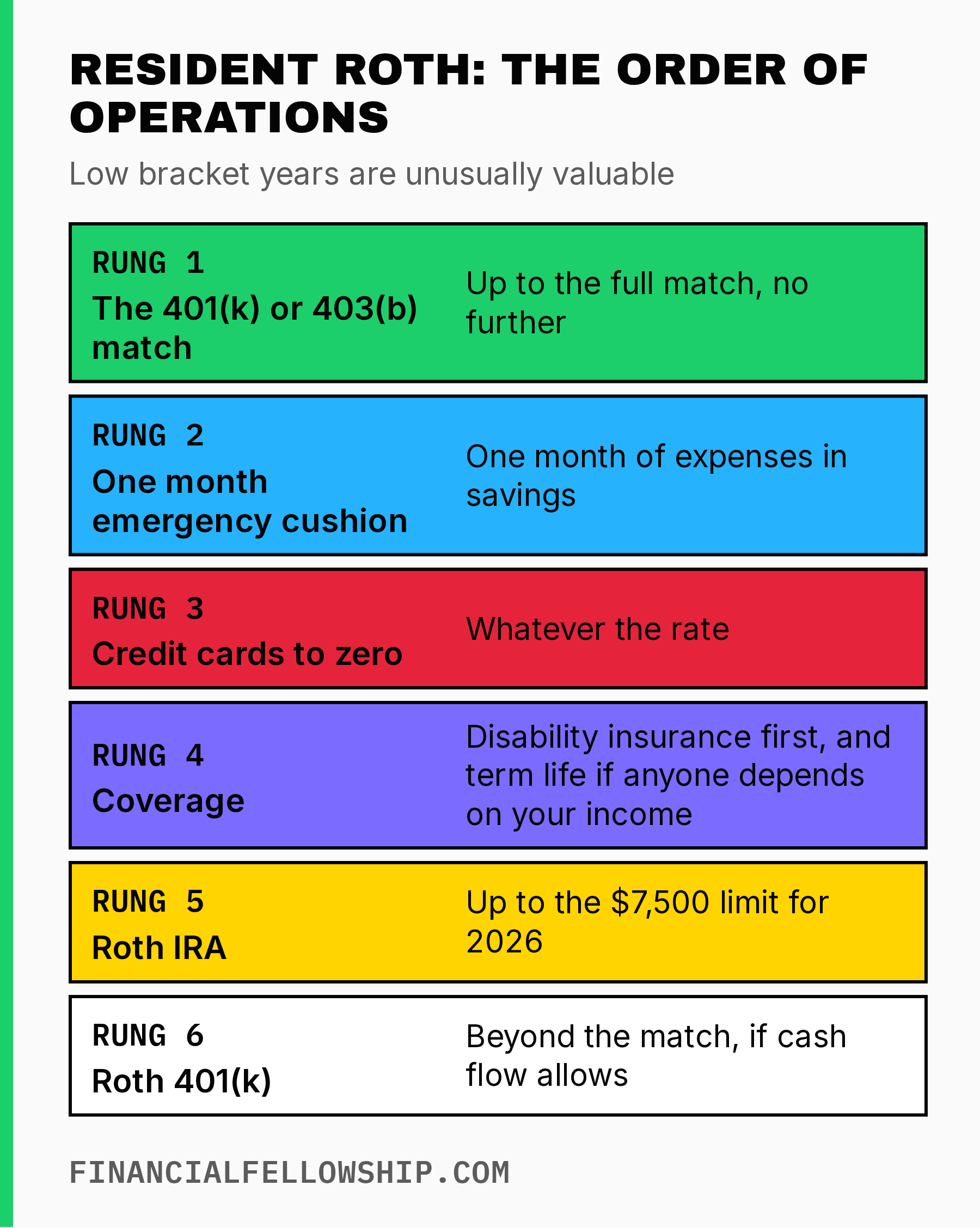
Contribute. Residency is likely the lowest tax bracket of your career, which is exactly when Roth contributions are cheapest: you pay tax now at a low rate and never again on that money. The order is the employer match first, then a one month emergency cushion, then the Roth IRA, then Roth 401(k). Do not skip retirement entirely to chase loans. Federal loans at income driven payments are cheap money during training, and the compounding years you skip in your late 20s do not come back.
Why is the Roth so powerful in residency?
Because of the bracket. A resident earning roughly $75,000 is in a far lower federal bracket than an attending earning $400,000 plus. Every Roth dollar contributed now is taxed at the resident's rate. Every Roth dollar contributed later is taxed at the attending's rate. Same account, same growth, very different tax cost.
The Roth IRA has a second advantage: flexibility. Contributions (not earnings) can be withdrawn without tax or penalty, which makes it a softer commitment than it looks. It is not an emergency fund, but it is not a locked vault either.
For 2026, the IRA contribution limit is $7,500 and the 401(k) elective deferral limit is $24,500 (IRS). You will not hit either on a resident salary. That is fine. The habit and the compounding matter more than the max.
Why does the match come first?
Because it is an instant return no loan payoff beats. If your program matches 50 percent of your contributions up to 6 percent of salary, every dollar you contribute up to that cap earns 50 percent immediately. No investment, no loan interest rate, no market return competes with an instant 50 percent.
Check whether your program offers a match and what the formula is. Not all do. If yours does, contributing up to the match gets the first dollars of your financial life, before the emergency cushion, before the Roth IRA, before extra loan payments, before everything.
One wrinkle: some program matches go into a pretax account even if your contributions are Roth. That is normal. The match is still free money.
Why not skip retirement and attack the loans?
Because the loans are cheap right now and the years are not. Federal loans on income driven repayment during residency have payments tied to your income, which keeps them manageable. Aggressively paying a 6 percent loan with dollars that could compound for 35 years is a trade that looks responsible and costs a fortune.
The math: $7,500 contributed to a Roth IRA at age 28, growing for 35 years, is worth far more than $7,500 of extra loan principal paid at age 28. The loan will be paid off at attending income in a few years either way. The compounding years cannot be recreated.
The exception is consumer debt. Credit cards go to zero whatever the rate, after the match and one month of reserves. Other debt above 7 percent waits until the retirement accounts are maxed and reserves reach three months. Then fund the Roth.
What is the actual order of operations?
First, the 401(k) or 403(b) match, if your program offers one. Up to the full match, no further.
Second, a small emergency cushion: one month of expenses in savings. Residents with no cushion put every surprise on a credit card, which is the most expensive financing available.
Third, credit cards to zero, whatever the rate. A card balance is the most expensive debt most residents carry, and it goes before any Roth dollar.
Fourth, coverage. Disability insurance first, and term life if anyone depends on your income.
Fifth, the Roth IRA, up to the $7,500 limit for 2026.
Sixth, Roth 401(k) contributions beyond the match, if cash flow allows.
Seventh, extra loan payments, but only against debt above 7 percent. Federal loans stay on income driven repayment.
This order is not close. The match is free money, the Roth locks in your lowest bracket years, and the federal loans are designed to be cheap during training.
What about moonlighting income?
If you moonlight as a 1099, you can open a Solo 401(k), including Roth Solo 401(k) contributions in a low bracket year. The employee deferral is one $24,500 limit shared with your residency plan. Only the employer side, about 20 percent of net self employment earnings, is extra. Moonlighting income aimed at a Roth Solo 401(k) is one of the highest value uses of that money. Just remember the taxes come first: quarterly estimates, then the retirement contribution, then spending.
The main points
- Resident bracket years are the cheapest Roth dollars you will ever buy.
- 2026 limits: $7,500 IRA and $24,500 401(k) elective deferral.
- Fund the Roth after the match, one month of reserves, cards at zero, and coverage.
- A Roth 401(k) beats a Roth IRA on limits. Do both if cash flow allows.
Related questions
What is the right student loan strategy on a resident salary: ride out income driven repayment toward PSLF, or plan to refinance as an attending?
Income driven repayment during residency, file the PSLF certification, do not refinance to private. The fork comes at graduation.
My moonlighting pay comes as 1099 income. What do I actually have to do about taxes?
Quarterly estimates, track expenses, consider a Solo 401(k), and keep the money separate until each quarterly payment clears.
Sources
Internal Revenue Service, IRA contribution limits for 2026 ($7,500). IRA Contribution Limits (accessed September 30, 2026)
Internal Revenue Service, 401(k) contribution limits for 2026 (elective deferral $24,500). 401(k) Plans (accessed September 30, 2026)
U.S. Department of Education, Federal Student Aid, Income Driven Repayment Plans. Income Driven Repayment Plans (accessed September 30, 2026)
Published September 30, 2026. Last reviewed October 11, 2026.