How do I run the money math on a cardiac, peds, pain, or regional fellowship versus going straight to attending?

By Ryan Inman
Published · Updated
The short answer
A fellowship year costs an attending salary and delays compounding. Run the gap math honestly before you decide the extra training is worth it.
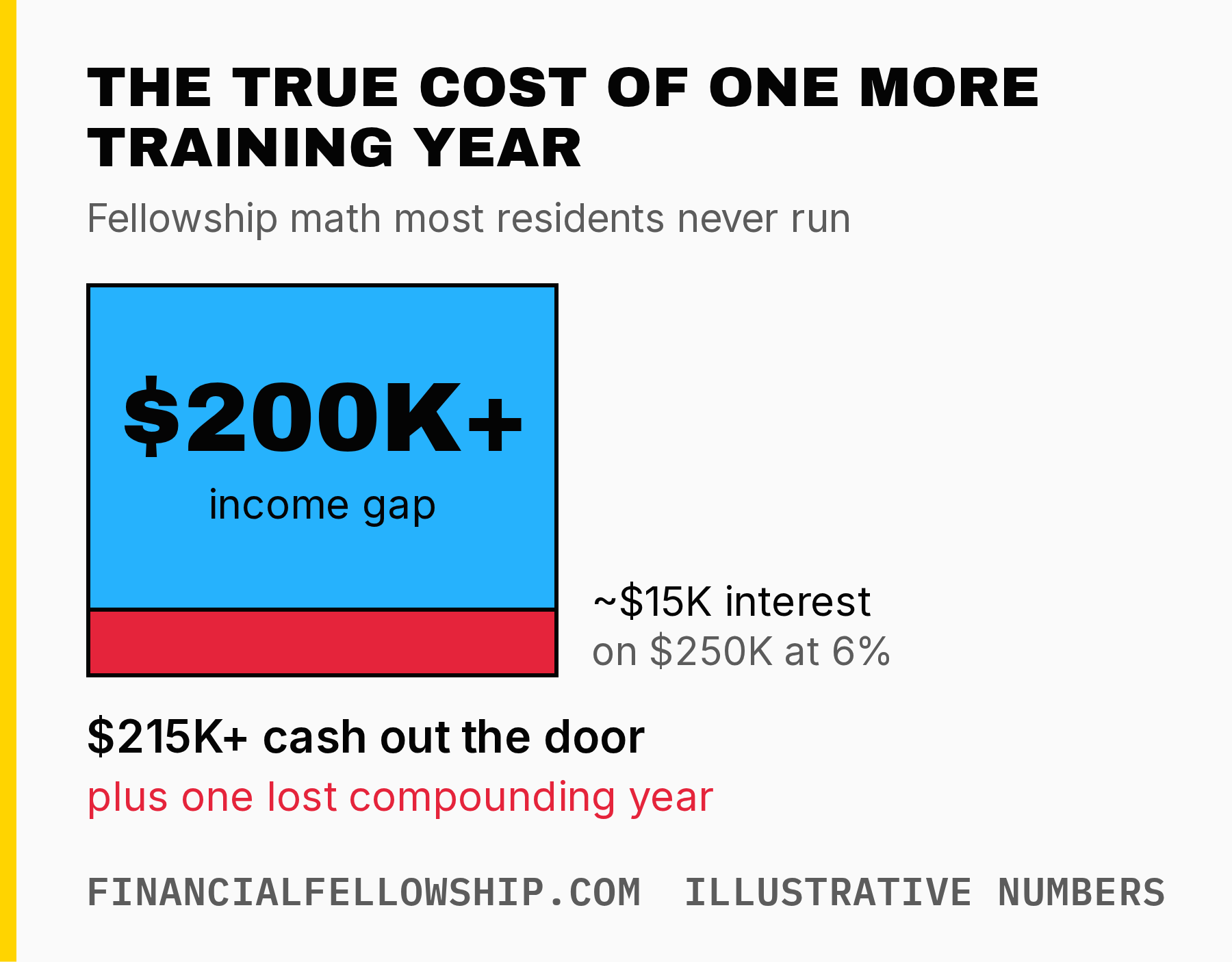
The fellowship year costs the gap between fellow pay and first year attending pay, often $200,000 plus, plus one more year of loan interest and one fewer year of attending level retirement contributions. The payoff has to be priced in the market you will actually work in. And if you would be miserable without the subspecialty, the math is a tiebreaker, not the decision.
What does the fellowship year actually cost?
Three components.
The income gap: first year attending pay minus fellow pay. For anesthesia, that gap is often $200,000 or more. That is the headline cost, and it is real money.
The loan cost: one more year of interest accrual on your student loans, and one more year before you can attack them at attending income. On a $250,000 balance at 6 percent, that is roughly $15,000 of interest for the fellowship year. These are illustrative numbers. Run your own balance and rate.
The retirement cost: one fewer year of attending level contributions. A year of maxed 401(k) contributions plus match in your early 30s compounds for 30 plus years. Missing that year does not just cost the contribution. It costs the growth.
Add the three and the fellowship year costs well into the six figures in true economic terms. That does not mean it is a bad deal. It means the payoff has to be real.
How do you price the payoff?
By market, not by prestige. The fellowship premium varies enormously by where and how you will practice.
Cardiac fellowship pays off in markets and practices that staff cardiac rooms with fellowship trained physicians. In those markets, the fellowship is the credential that gets you the job and the pay. In markets where general anesthesiologists do cardiac cases, the premium is small and the fellowship year may never pay back financially.
Peds fellowship works the same way: valuable where children's hospitals and high acuity peds practices require it, modest premium elsewhere.
Regional fellowship is the subtlest case. Regional skills are valuable everywhere, and many general anesthesiologists build strong regional practices without the fellowship year. The fellowship buys depth and the credential. Whether that depth pays depends on whether your target practice differentiates on it.
So the question is not "does the fellowship pay?" It is "does the fellowship pay in the market I will actually work in?" Talk to anesthesiologists in your target market, not just your program's faculty. Faculty at an academic center see the academic market. You might be heading somewhere else.
Why is pain different?
Pain is the outlier because it changes the job, not just the pay. A pain fellowship moves you from OR anesthesia to clinic based procedural practice: different income structure, different call burden, different business risk.
Compare pain as a different career, not a pay bump. The questions change: do you want clinic ownership or employment? Do you want procedural volume risk? Do you want to manage chronic pain patients longitudinally? The income can be higher, but the job is unrecognizable next to OR anesthesia, and the burnout profile is different.
Run the money math on pain separately, with pain physicians in your target market, and weight the non money factors heavily. People who love pain practice do very well. People who chose it for the money and hate clinic often do not last.
What about the non money factors?
They decide close calls. If you would be miserable doing general anesthesia without the subspecialty, the math is a tiebreaker. Thirty years of work you enjoy beats a financially optimal fellowship year you resent.
The factors that belong in the decision: which cases energize you, where you want to live (some subspecialties cluster in certain markets), what call burden you want, and whether you want academic or private practice (fellowships matter more in academics).
One more: the fellowship year is also a networking and credentialing year. The connections and the letters from a strong fellowship program have value that never shows up in the income gap math, especially for academic careers.
What is the decision rule?
Price the three costs honestly. Price the payoff in your target market, not in the abstract. Then let the non money factors decide close calls.
The mistake is doing this backwards: choosing the fellowship for prestige or default, then discovering the premium does not exist in your market. Or skipping a fellowship you love because the income gap scared you, then spending a career wishing you had done it.
For an anesthesiologist, the fellowship decision is also a geography decision. Subspecialty premiums are local. Decide where you want to live first, then check whether the fellowship pays there.
Framework box: pricing the fellowship year
| Cost | How to estimate |
|---|---|
| Income gap | First year attending pay minus fellow pay in your market |
| Loan cost | One year of interest on your balance at your rate |
| Retirement cost | One year of missed attending level contributions plus decades of growth |
| Payoff | Premium for the subspecialty in your target market, over how many years |
The main points
- A fellowship year forgoes roughly one year of attending income plus compounding.
- Compare lifetime earnings with and without the fellowship, not just starting salaries.
- Fellowships that meaningfully raise hourly rates or open otherwise closed jobs can still win.
- Do not forget the loan math: another year of payments or another year of interest.
Related questions
How much does geography change what an anesthesiologist earns, and how should I use that as a resident choosing where to apply?
Enormously. Price the fellowship premium in the market you will actually work in, because subspecialty premiums are local.
Cardiac fellowship vs general practice: which markets actually pay the premium?
The premium exists where practices staff cardiac rooms with fellowship trained physicians. In other markets it is small. Talk to anesthesiologists in your target market.