My group LTD caps at $10k to $15k a month but I earn several times that. How do I close the disability gap at peak income?

By Ryan Inman
Published · Updated
The short answer
Group LTD that caps at $10k to $15k a month covers a fraction of peak anesthesia income. Close the gap with individual own occupation coverage while you are still insurable.
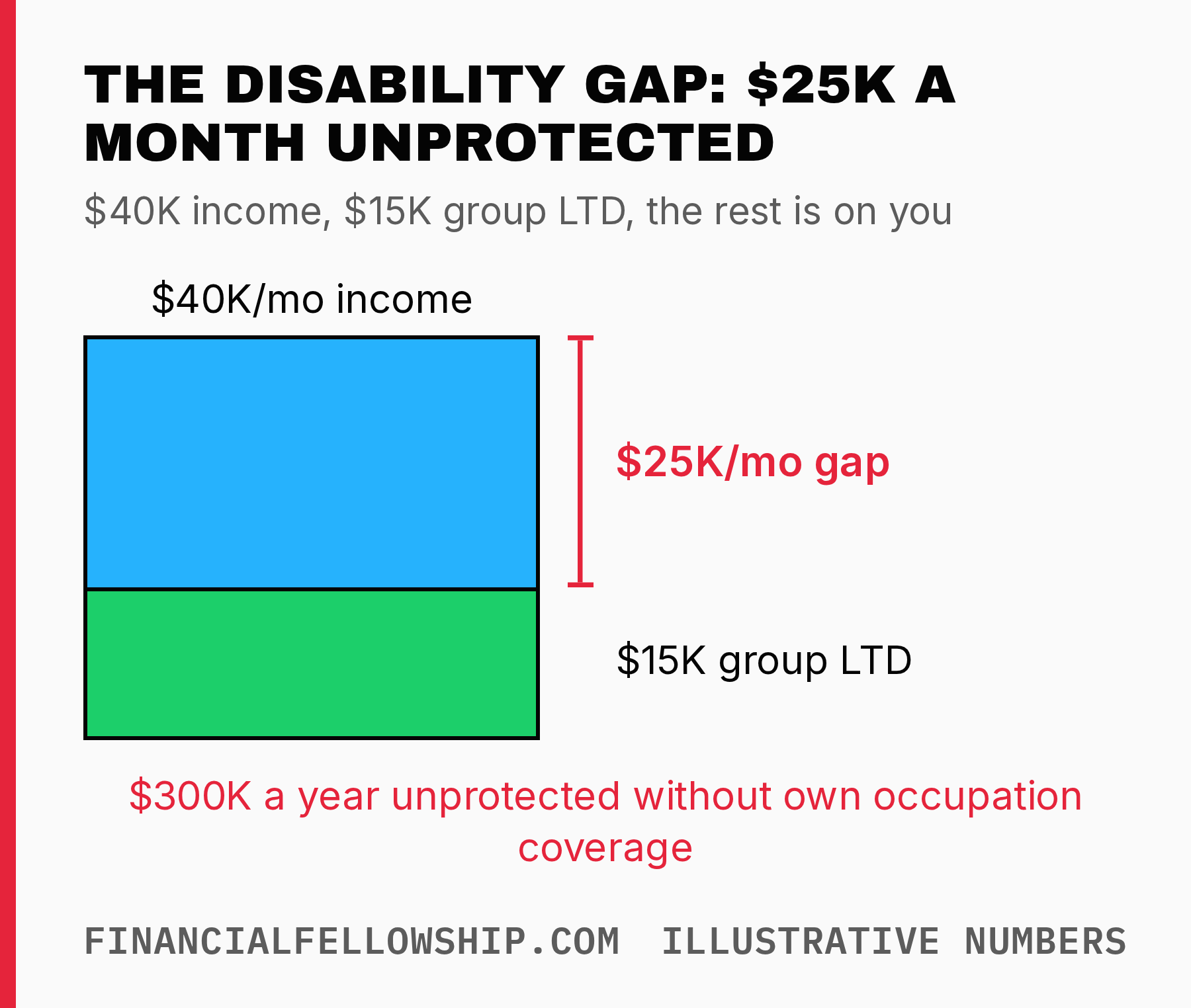
With a supplemental individual own occupation policy sized to the gap, bought while you are healthy. Group long term disability is designed for the average employee, not a peak earning anesthesiologist: a $15,000 monthly cap on a $40,000 monthly income replaces barely a third of earnings. Each year you wait, the premium rises and insurability risk grows. And read the group plan's coordination of benefits before you buy, or you can pay for coverage that never pays out.
How big is the gap?
Do the arithmetic. Take your monthly gross income. Subtract the group plan's monthly cap. The difference is the gap.
On $480,000 a year ($40,000 a month) with a $15,000 group cap, the gap is $25,000 a month, or $300,000 a year of unprotected income. On a $10,000 cap, the gap is $30,000 a month. These are illustrative numbers. Your income and your plan's cap are what matter.
Then check the group plan's definition of disability. Many group plans use a weaker definition than individual own occupation policies, and some switch to an "any occupation" definition after a set period. A $15,000 cap with a weak definition is worse than the cap alone suggests, because the benefit you are counting may not pay when you need it.
Also check taxability. If the employer pays the group premium, the benefit is usually taxable income. A $15,000 monthly benefit taxed at high earner rates is worth meaningfully less than $15,000. If you pay the premium yourself with after tax dollars, the benefit is generally tax free (IRS Publication 525).
What does the supplemental policy look like?
An individual own occupation policy, sized to the gap, with the specialty specific definition. For an anesthesiologist, the definition must cover your specialty's material duties: procedural work, airway management, the physical demands of long cases.
Size it to the gap, not to the full income. If the group covers $15,000 and the gap is $25,000, the supplemental policy targets the $25,000. Overbuying wastes premium. Underbuying leaves the gap open.
Buy it while you are healthy. Every year you wait, two things happen: the premium rises with age, and the chance of a new diagnosis that draws an exclusion or a rating grows. At peak earning years, you are also at the age where health histories start accumulating. The window does not stay open.
If you bought a resident policy with a future purchase option, this is the moment the option exists for. Exercise it. That is what you paid for.
What is the coordination trap?
Read the group plan's coordination of benefits provision before you buy the supplement. Some group plans offset their benefit against individual disability benefits: if you receive $25,000 from your individual policy, the group plan reduces its payment.
The trap version: you pay premiums for years on a supplemental policy, become disabled, and discover the group plan offsets dollar for dollar, which means the supplement bought you nothing. The group plan's offset language decides whether the two policies stack or cancel.
This is in the group plan's certificate, not in the HR summary. Pull the certificate. If the offset exists, the math changes: you may need a larger individual policy, or a different structure, or a conversation with a broker who understands coordination.
What about business overhead expense insurance?
The companion product owners miss. If you are a partner, disability does not just stop your income. It leaves your share of the practice overhead running: rent, staff, equipment leases, loan payments.
Business overhead expense insurance pays the practice's overhead during your disability, typically for 12 to 24 months. Its job is practice preservation, separate from income replacement: it keeps the lights on and the staff paid while you recover or while the buy out is arranged.
Partners in private groups should price this alongside the individual disability policy. The income gap and the overhead gap are two different holes, and one policy does not fill both.
What is the decision rule?
Measure the gap with your real numbers. Buy the individual own occupation supplement sized to it, while you are healthy. Read the coordination provision before you buy. Add overhead expense coverage if you are an owner.
And revisit the total every few years. Income rises, group plans change, health changes. The disability plan is not a purchase. It is a position, and positions need maintenance.
Framework box: closing the gap
| Step | Action |
|---|---|
| 1 | Compute the gap: monthly income minus group cap |
| 2 | Check the group definition and taxability |
| 3 | Read the coordination of benefits provision |
| 4 | Buy individual own occupation sized to the gap |
| 5 | Add business overhead expense coverage if an owner |
| 6 | Revisit every few years |
The main points
- A $15,000 monthly group cap on a $40,000 monthly income replaces barely a third of earnings.
- Individual own occupation policies stack on top of group coverage.
- Buy while young and healthy. The price only rises and availability only falls.
- Business overhead expense coverage protects the practice side separately.
Related questions
Should I buy individual disability insurance during residency, or wait until I am an attending with a real salary?
Buy during residency if healthy and the premium fits. The future purchase option is the mechanism that scales the small resident policy to attending income without new underwriting.
LTD, life, 401(k) and 403(b) match, tail, licenses, DEA, CME, boards bonus: which benefits change the winner when bases are close?
When bases are close, benefits decide. The disability own occupation definition is the most important line. Read it before the premium.
Sources
- Internal Revenue Service, Publication 525, Taxable and Nontaxable Income (disability benefits taxation). Publication 525 (accessed September 30, 2026)
Published September 30, 2026. Last reviewed September 30, 2026.