I want to cut back to 0.8 FTE or drop call. What is the financial math of stepping back clinically?

By Ryan Inman
Published · Updated
The short answer
Cutting to 0.8 FTE rarely cuts pay by exactly 20 percent. Call, benefits cliffs, and fixed costs change the math. Run it before you announce.
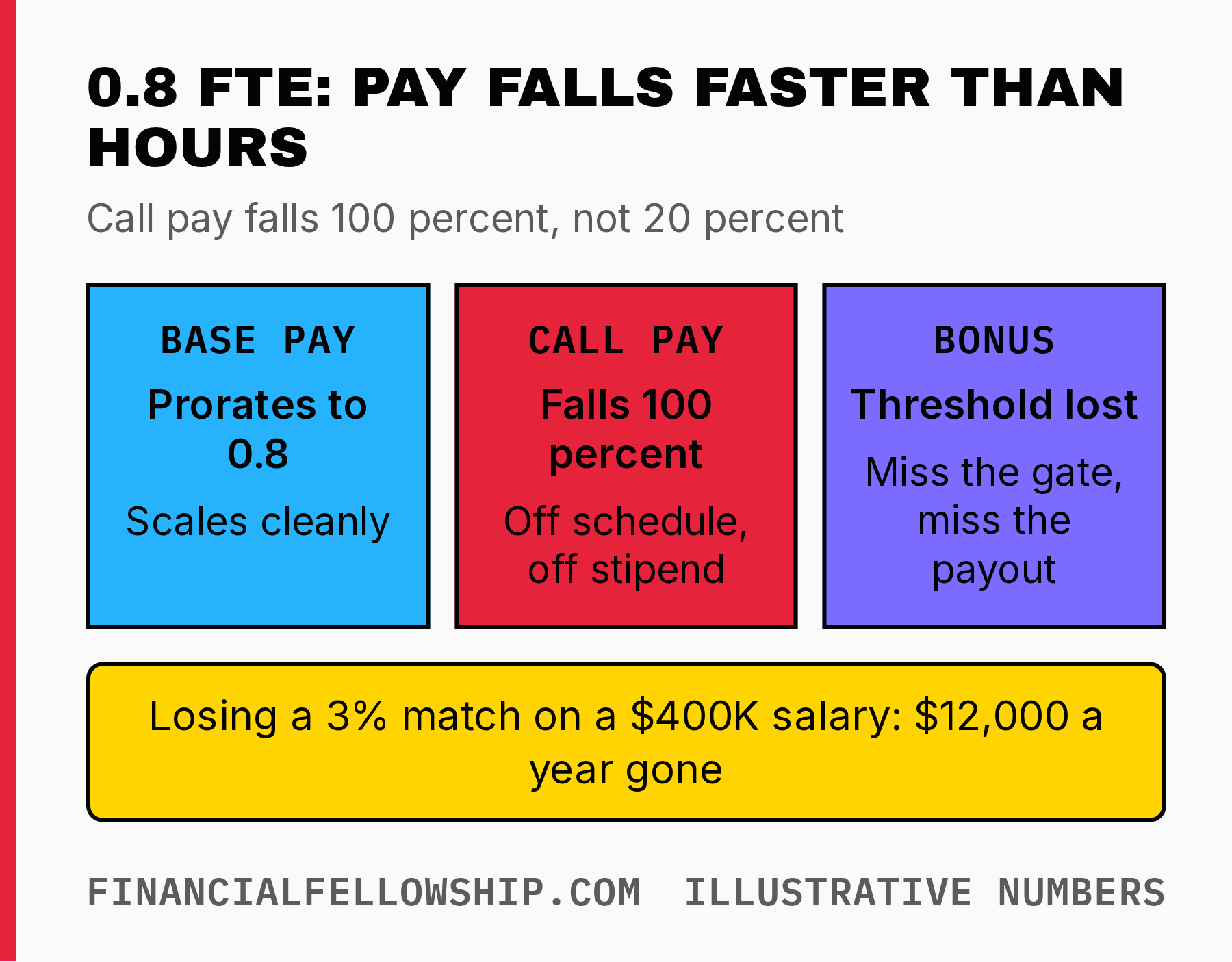
Cutting clinical days rarely cuts pay proportionally. Call pay, stipends, and productivity bonuses often fall faster than base, so model the actual new number with your group's formula, not a straight 20 percent haircut. Watch the benefits cliffs: dropping below full time can cost health insurance, the 401(k) match, disability coverage, and CME dollars. And test it before committing: negotiate a one year trial at reduced FTE with a defined path back.
Why isn't it proportional?
Because attending pay is not one number. It is a stack: base salary, call pay, productivity bonuses, stipends for medical direction or leadership, and sometimes profit distributions. When you cut days, the base usually prorates. The rest often does not.
Call pay is the biggest non linearity. If you drop call entirely, you lose 100 percent of the call pay, not 20 percent. In many anesthesia jobs, call pay and call related bonuses are 15 to 30 percent of total compensation. Dropping call can cut total pay by much more than the FTE reduction suggests. These ranges are illustrative. Your formula is what matters.
Productivity bonuses have thresholds. If the bonus kicks in above a unit count you no longer hit at 0.8 FTE, you lose the whole bonus, not 20 percent of it. Stipends for roles you keep may survive. Stipends tied to full time status may not.
So the math: take your group's actual formula, plug in the reduced schedule, and compute the real number. Do not multiply by 0.8. That is the mistake this article exists to prevent.
What are the benefits cliffs?
Dropping below full time can trigger cliffs that cost more than the pay cut.
Health insurance: many employer plans require full time status. Losing employer health insurance at peak earning age means buying on the open market, which is expensive, especially for a family. Price the replacement before you step back.
Retirement match: some matches require full time status or a minimum hours threshold. Losing a 3 percent match on a $400,000 salary is $12,000 a year of free money gone. These figures are illustrative.
Disability coverage: group long term disability may not cover part time physicians, or may cover at reduced levels. If your individual supplemental policy was sized assuming the group base layer, the gap just grew. Check both.
CME dollars and days: often prorated or eliminated below full time. Smaller dollars, but they signal how the group values the reduced role.
The cliffs are in the plan documents, not in the offer letter. Read them before you negotiate the schedule change.
Is dropping call better than dropping days?
Often, yes, as a negotiation. Many groups will trade a reduced call schedule for a pay cut more readily than reduced days, because call is the scarce resource and days are the coverage.
No call has a quality of life value worth pricing explicitly. What would you pay to never take call again? For many anesthesiologists at mid career, the answer is a large number. If the group offers a no call track at a 25 percent pay cut and your number is higher than that, it is a good trade.
The hybrid versions: no in house call but home call retained, call capped at a number per month, or a call buyout where you pay colleagues to take your shifts. Each has different economics. Model each one.
How do you test it?
Negotiate a one year trial at reduced FTE with a defined path back. Groups rarely volunteer the return trip in writing, which is why you negotiate it upfront.
The trial terms: the reduced schedule and pay for one year, the benefits treatment during the trial, and the specific mechanism for returning to full time (notice period, guaranteed slot, no reapplication). Get the return path in the same document as the reduction.
The trial protects both sides. You learn whether the reduced schedule actually delivers the life improvement you want. The group learns whether coverage works. If it does not work, for either side, the path back is already agreed.
What is the decision rule?
Model the real number with the formula, price the benefits cliffs, negotiate the trial with the return path in writing. Then decide whether the life improvement is worth the true cost.
One more consideration: the step back is often reversible in theory and sticky in practice. Groups get used to the reduced schedule. Colleagues absorb the call. The path back exists on paper but gets socially harder. The written return right matters precisely because the unwritten one erodes.
For an anesthesiologist, stepping back from call is also a longevity move. The physicians who sustain long careers in this specialty usually engineer the call burden down over time. Doing it deliberately, with the math done, beats doing it reactively after burnout.
Framework box: the step back math
| Item | What to model |
|---|---|
| New pay | Formula at reduced schedule, not base times 0.8 |
| Call pay lost | Often 100% of call pay, not prorated |
| Bonus thresholds | Do you still clear them? |
| Health insurance | Full time requirement? Replacement cost? |
| Match and disability | Hours thresholds in plan documents |
| Trial terms | One year, benefits treatment, written path back |
The main points
- Do not assume linear pay. Call and differentials often fall faster than FTE.
- Watch benefits cliffs: health coverage and retirement matches can drop at thresholds.
- Model the after tax monthly number, not the gross FTE fraction.
- Negotiate the call reduction explicitly. 0.8 FTE with full call is the worst of both.
Related questions
My initial guarantee expired and I am on the productivity formula now. How do I renegotiate from a position of strength at year three to five?
If the group cannot move on rate, negotiate structure: schedule control, vacation, CME, a path to reduced call, or a retention bonus with clean terms.
Should I do locums as a bridge toward retirement, or as a mid career reset?
Locums buys schedule control without the benefits cliffs, but it strips out stability. Price the 1099 rate against W2 total comp before calling it a raise.