Senior partners are retiring and the group wants me to help buy them out. How do I value their shares without overpaying?

By Ryan Inman
Published · Updated
The short answer
Buying out retiring partners means pricing their shares without overpaying. The buyout formula should have been set years ago. If it was not, negotiate it now with clear eyes.
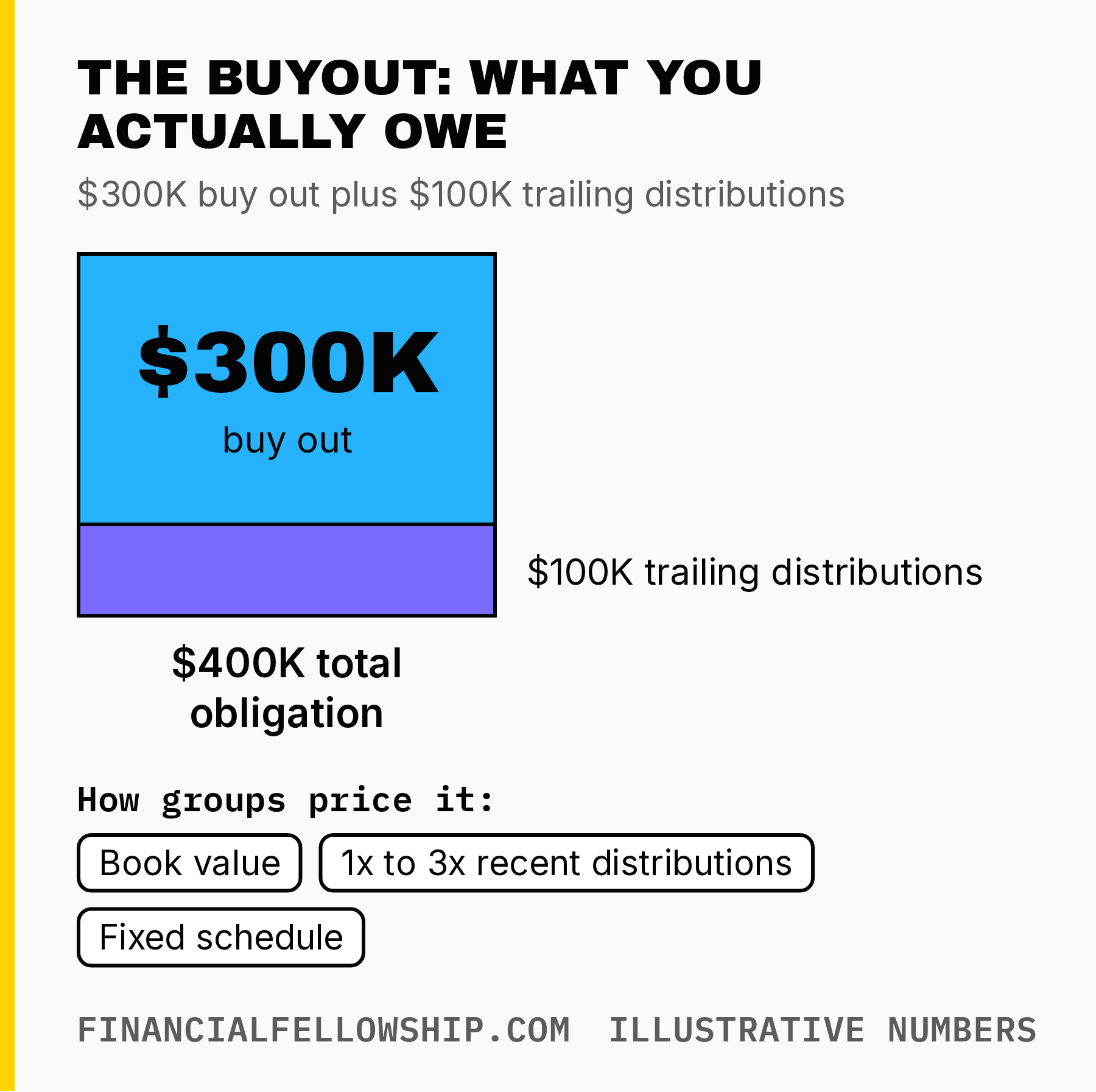
A retiring partner's shares are worth the group's agreed buy out formula, which should already exist in the partnership agreement. If it does not, negotiate the formula before anyone's retirement forces a number. Price the full obligation, not just the share purchase price: retiring partners often keep getting paid through trailing distributions or deferred compensation. And price the call redistribution, because every retirement concentrates nights and weekends on whoever remains.
Why does the formula have to come first?
Because negotiating a price under deadline, with a retiring partner waiting, is how groups overpay. The buy out formula should be a standing term in the partnership agreement, agreed when nobody was retiring and everyone could think clearly.
If the formula exists, the valuation question is mechanical: apply the formula to the current numbers. If it does not exist, stop and negotiate the formula before you negotiate any individual retirement. The formula is the precedent for every retirement after this one, including yours.
What are the common formula structures?
Book value: the partner's share of the group's book value (assets minus liabilities). Simple, objective, and usually the lowest number. It favors the buyers.
Multiple of recent distributions: the share price set as a multiple of the partner's average distributions over the last few years. Common multiples run 1x to 3x. This favors the seller when the group is doing well and the buyer when it is not. The lookback period matters: a three year average smooths a bad year, a one year average does not.
Pre agreed fixed schedule: the agreement sets the buy out price by year, or a flat amount per share. Predictable, but it can drift from reality if the group's economics changed since the schedule was written.
Each structure favors a different side. Understand which one your agreement uses and why. If you are negotiating the formula fresh, push for the structure that matches the group's actual economics, not the one that produces the number the retiring partner wants to hear.
What is the full obligation?
The share purchase price is not the whole cost. Retiring partners often keep getting paid after the buy out through trailing distributions or deferred compensation: a share of collections for cases they did, a payout over years, or a consulting arrangement.
Price the full obligation: the buy out payment, plus the trailing payments, plus the timeline. A $300,000 buy out paid over five years at no interest is a different obligation from $300,000 at close. And a $300,000 buy out plus $100,000 in trailing distributions is a $400,000 obligation wearing a $300,000 price tag. These figures are illustrative. Your agreement's numbers are what matter.
Also check who funds it. Does the group pay from operating cash, which reduces everyone's distributions? Do the remaining partners get assessed? Is there a sinking fund? The funding mechanism decides whose money pays for the retirement.
What is the hidden cost?
Call redistribution. Every retirement concentrates nights, weekends, and holidays on the remaining partners. The buy out math should include what the schedule change is worth to you.
This is the cost nobody puts in the spreadsheet. A senior partner who took a light call schedule in their last years was still taking some call. When they leave, that call does not disappear. It redistributes. If the group does not replace them, which is common, your schedule gets heavier at exactly the moment you paid for the privilege.
Price it honestly. What would you pay to avoid the additional call burden? That number belongs in the buy out analysis, because it is part of what the retirement costs you.
There is also a recruitment cost. If the group needs to replace the retiring partner, the search costs, the sign on, and the ramp up period are real expenses. If the group does not replace them, the call cost above applies. Either way, the retirement is not free.
What is the decision rule?
Apply the formula if it exists. Negotiate the formula first if it does not. Price the full obligation including trailing payments and the funding mechanism. Price the call redistribution. Then decide whether the buy out, at its true total cost, is worth it.
And think about your own retirement while you are at it. The formula you agree to now is the formula that will value your shares later. Negotiate it as a future seller, not just as a current buyer.
Framework box: the buy out checklist
| Item | Question to answer |
|---|---|
| Formula | Does the agreement have one? Which structure? |
| Full price | Buy out plus trailing distributions plus deferred comp |
| Funding | Group cash, partner assessments, or sinking fund? |
| Payout terms | Lump sum or installments? Interest? |
| Call impact | Who absorbs the retiring partner's call? |
| Your future | Is this the formula you want for your own exit? |
The main points
- A standing buyout formula in the partnership agreement prevents deadline pricing.
- Value the practice on sustainable cash flow, not a single good year.
- Account for the full obligation: shares plus any tail, call redistribution, and coverage gaps.
- Negotiate from data on a normal week, not from emotion after a bad month.
Related questions
My group is offering partnership and a buy in number. How is an anesthesia buy in actually priced, and how do I decide if it is fair?
Same mechanics in reverse. Price the formula, the audited numbers, the partner premium, and the buy out terms before you buy in.
Our group is selling to private equity. As a physician owner, what happens to my proceeds, my taxes, and my job?
If a sale is on the horizon, the buy out formula interacts with the sale proceeds. Understand both before you fund a retirement.