Physician Annual Numbers, 2026
Every number on this page was read from its primary source on 2026-10-02 and is date stamped below. This page refreshes every year. When a number changes, the reviewed date changes with it.
Last reviewed: 2026-10-02.
Why this page exists
Physician money content is full of last year's numbers quoted as this year's. Contribution limits, phaseouts, brackets, and loan rates all move annually, and stale numbers produce wrong decisions. This is the shared source of truth: every guide, calculator, and hub page on this site cites these figures, and every figure traces to the document that set it.
Retirement accounts
| 2026 | |
|---|---|
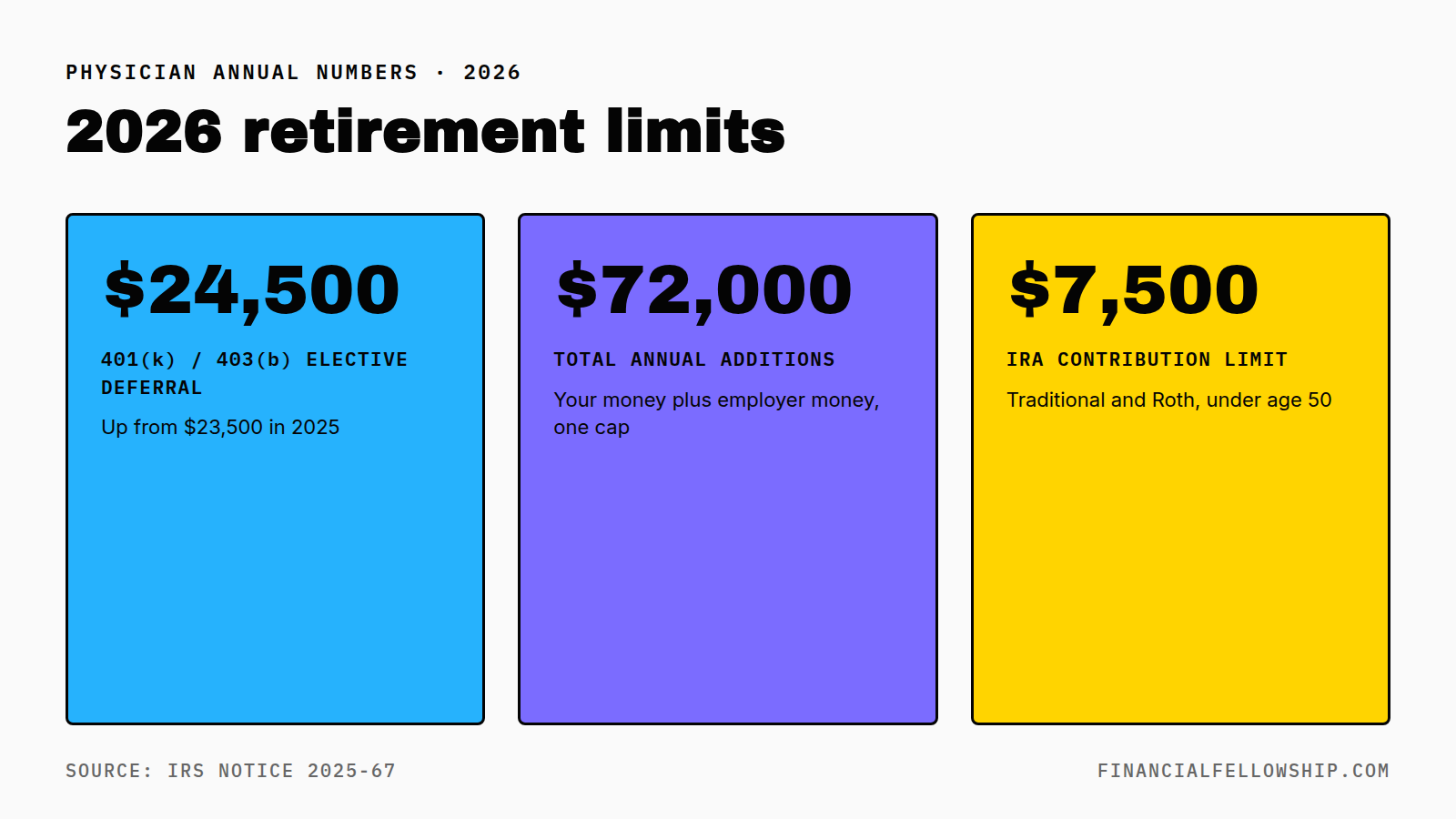
| 401(k), 403(b), governmental 457(b) elective deferral | $24,500 |
| Total annual additions (employer plus employee) | $72,000 |
| Catch up, age 50 and older | $8,000 |
| Catch up, ages 60 to 63 | $11,250 |
| SEP IRA max | $72,000 |
Source: IRS Notice 2025-67. Retrieved 2026-10-02.
New for 2026: if your 2025 wages exceeded $150,000, catch up contributions must go in as Roth. That is SECURE 2.0 section 603, effective this year.
IRAs
| 2026 | |
|---|---|
| Traditional and Roth IRA contribution limit, under 50 | $7,500 |
| Catch up, age 50 and older | $1,100 (total $8,600) |
Roth IRA direct contribution phaseout, 2026:
| Filing status | Full contribution | Phaseout | No direct contribution |
|---|---|---|---|
| Single | Under $153,000 MAGI | $153,000 to $168,000 | $168,000 and up |
| Married filing jointly | Under $242,000 MAGI | $242,000 to $252,000 | $252,000 and up |
Most attending physicians land above the direct Roth limit. That is what the backdoor Roth exists for.
Traditional IRA deductibility phaseout (covered by a workplace plan), 2026: single $81,000 to $91,000. Married filing jointly $129,000 to $149,000.
Source: IRS Notice 2025-67 via IRS newsroom. Retrieved 2026-10-02.
HSA
| 2026 | 2027 (announced) | |
|---|---|---|
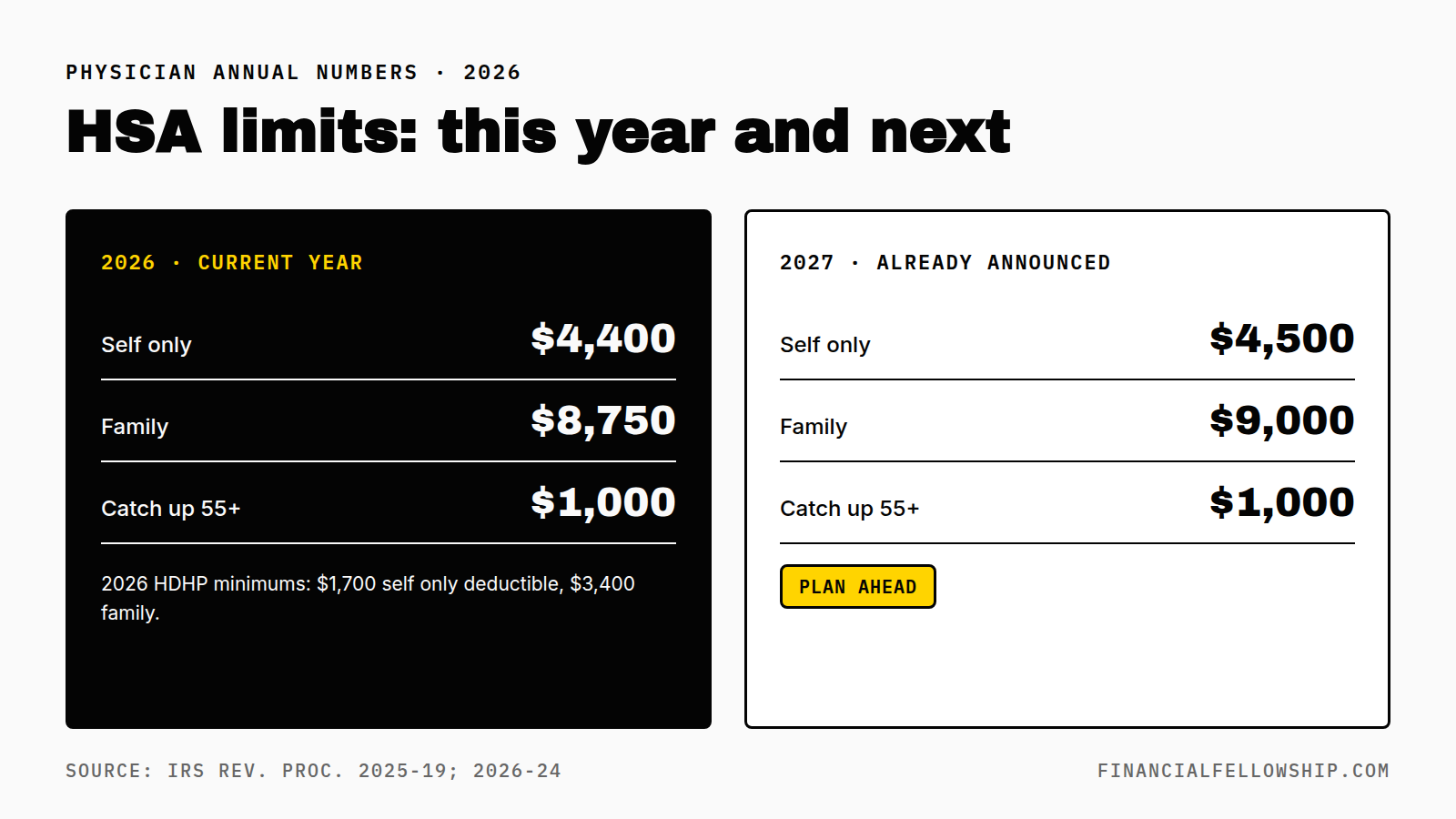
| Self only coverage | $4,400 | $4,500 |
| Family coverage | $8,750 | $9,000 |
| Catch up, age 55 and older | $1,000 | $1,000 |
2026 HDHP minimums: $1,700 deductible self only, $3,400 family. Out of pocket max $8,500 self only, $17,000 family. 2027 HDHP minimums are already announced: $1,750 self only, $3,500 family. Out of pocket max $8,700 self only, $17,400 family.
Sources: IRS Rev. Proc. 2025-19 (2026). IRS Rev. Proc. 2026-24, released 2026-05-29 (2027). Retrieved 2026-10-02.
Income tax
Standard deduction, 2026:
| Filing status | Amount |
|---|---|
| Single | $16,100 |
| Married filing jointly | $32,200 |
| Head of household | $24,150 |
Source: IRS Rev. Proc. 2025-32. Retrieved 2026-10-02.
Federal brackets, 2026 (taxable income):
| Rate | Single | Married filing jointly |
|---|---|---|
| 10% | $0 to $12,400 | $0 to $24,800 |
| 12% | $12,401 to $50,400 | $24,801 to $100,800 |
| 22% | $50,401 to $105,700 | $100,801 to $211,400 |
| 24% | $105,701 to $201,775 | $211,401 to $403,550 |
| 32% | $201,776 to $256,225 | $403,551 to $512,450 |
| 35% | $256,226 to $640,600 | $512,451 to $768,700 |
| 37% | Over $640,600 | Over $768,700 |
Source: IRS Rev. Proc. 2025-32. Retrieved 2026-10-02.
New for 2026: filers age 65 and older get a $6,000 deduction per qualifying person, whether they itemize or take the standard deduction. It phases out at 6 percent once MAGI passes $75,000 single or $150,000 joint. Source: IRS newsroom, 2026 tax updates under the One Big Beautiful Bill Act. Retrieved 2026-10-02.
Child tax credit: $2,200 per qualifying child for 2026, $1,700 refundable portion (IRS Rev. Proc. 2025-32, section 4.05). Federal estate tax exemption: $15 million per person (IRS Rev. Proc. 2025-32, section 2.14).
Payroll tax
Social Security wage base, 2026: $184,500. Source: Social Security Administration announcement, October 2025. Retrieved 2026-10-02.
Additional 0.9% Medicare tax applies to wages over $200,000 single or $250,000 married filing jointly. Those thresholds are statutory and do not adjust for inflation.
Student loans
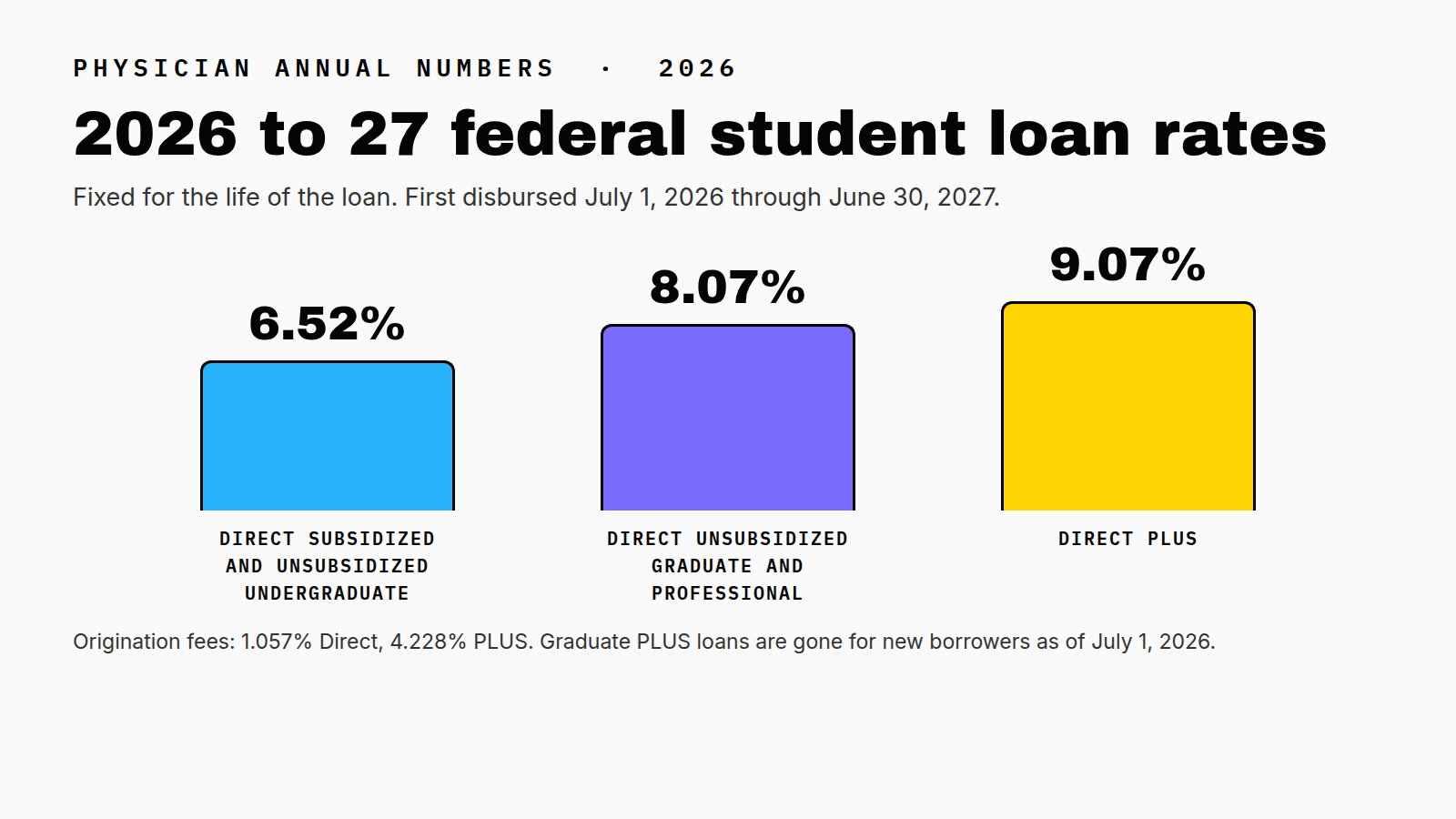
Federal Direct loan rates, first disbursed July 1, 2026 through June 30, 2027 (fixed for the life of the loan):
| Loan type | Rate |
|---|---|
| Direct Subsidized and Unsubsidized, undergraduate | 6.52% |
| Direct Unsubsidized, graduate and professional | 8.07% |
| Direct PLUS | 9.07% |
Origination fees: 1.057% Direct, 4.228% PLUS. Source: Federal Student Aid. Retrieved 2026-10-02.
PSLF, cumulative through January 2026: more than 1.2 million borrowers forgiven, $90.6 billion total, average relief near $75,000 per borrower. Source: Brookings analysis of Department of Education data. Retrieved 2026-10-02.
What changed vs 2025
- The One Big Beautiful Bill Act (signed July 2025) made the TCJA individual tax provisions permanent and reset several 2026 baselines: standard deduction, brackets, and a new $6,000 deduction for filers 65 and older.
- 401(k) deferral rose from $23,500 to $24,500. Total additions rose from $70,000 to $72,000. IRA limit rose from $7,000 to $7,500.
- The 2026 catch up Roth rule is new: 2025 wages over $150,000 means catch ups must be Roth.
- Graduate PLUS loans are gone for new borrowers as of July 1, 2026. Current borrowers may be grandfathered up to three years.
- The SAVE plan is no longer available. The Repayment Assistance Plan is the current income driven option.
- HSA 2027 limits are already announced: $4,500 self only, $9,000 family.
The refresh ritual
Every January this page gets rebuilt from primary sources: the IRS notice (retirement limits, October), the tax Revenue Procedure (brackets and standard deduction, October), the HSA Revenue Procedure (May), and the Federal Student Aid rate announcement (May/June). The reviewed date at the top always reflects the last full pass. 2027 retirement and tax figures arrive in October 2026 and will be added the day they publish.
The short version
- The 2026 elective deferral limit for 401(k), 403(b), and governmental 457(b) plans is $24,500, with total annual additions capped at $72,000.
- The 2026 IRA contribution limit is $7,500 under age 50, plus a $1,100 catch up at age 50 and older for a total of $8,600.
- New for 2026, catch up contributions must go in as Roth if your 2025 wages exceeded $150,000.
- The 2026 HSA limit is $4,400 for self only coverage and $8,750 for family coverage, with an extra $1,000 catch up at age 55 and older.
- The 2026 Social Security wage base is $184,500, and the standard deduction is $16,100 for single filers and $32,200 for married filing jointly.