Should I pay off my student loans aggressively or invest as a new attending?

Physician finance
Do both, in order. The match goes first, then one month of reserves, cards to zero, and coverage. Then compare your loan rate to a realistic after tax return.
Do both, in order. First capture any employer match. Then one month of reserves, every credit card to zero, and coverage in place. Then the student loan plan, the backdoor Roth, and your pretax and Roth retirement accounts filled to the limit, because unused space in those accounts is gone every year. With the money left over, compare your loan rate to the return you'd realistically expect after taxes. Debt above 7 percent gets extinguished at its step in the order, after the retirement accounts are maxed and the reserve holds three months. Below 7 percent, the money keeps flowing down the waterfall. If you're pursuing PSLF, never prepay.
Why do retirement accounts come before extra loan payments?
Retirement accounts come first because the space expires. You can prepay a loan any month of any year. You can't go back and make a 2026 401(k) contribution in 2029. For 2026, the employee 401(k) deferral limit is $24,500 and the IRA limit is $7,500 (IRS, 2026 contribution limit announcement). A new attending in a high bracket also gets an immediate tax break on every pretax dollar, which is a return the loan can't match.
The employer match comes before everything, including extra loan payments. A 50 percent match is a 50 percent return the day the money lands.
After the match and one month of reserves, every credit card goes to zero, whatever the rate, before anything else gets a dollar.
For a new attending, the first three years set the pattern for the whole career, so the order you pick now tends to stick.
Is paying off a 6.5 percent loan the same as earning 6.5 percent?
Close, and it's guaranteed. Every dollar of prepayment earns the loan rate, with no market risk. Most attendings earn too much to take the student loan interest deduction, which phases out at incomes well below a physician salary (IRS Topic 456), so there's no tax break shrinking that return.
Investing in a taxable brokerage account has a higher expected return over a decade but no guarantee, and you pay tax on dividends every year and on gains when you sell. So the fair comparison is your loan rate against an expected after tax return with risk attached, not against the stock market's best decade.
What does the math look like with real numbers?
Take a new attending with $200,000 of loans at 6.5 percent, retirement accounts already maxed, and $5,000 a month left to split between the loans and a brokerage account. Compare two plans over 10 years.
Plan A throws the full $5,000 at the loans. They're gone in about 46 months, with about $26,000 of total interest. Then the full $5,000 goes into the brokerage account for the remaining 74 months.
Plan B pays the 10 year standard payment of about $2,271 a month, which costs about $72,500 in interest over 10 years. It invests the other $2,729 every month from day one.
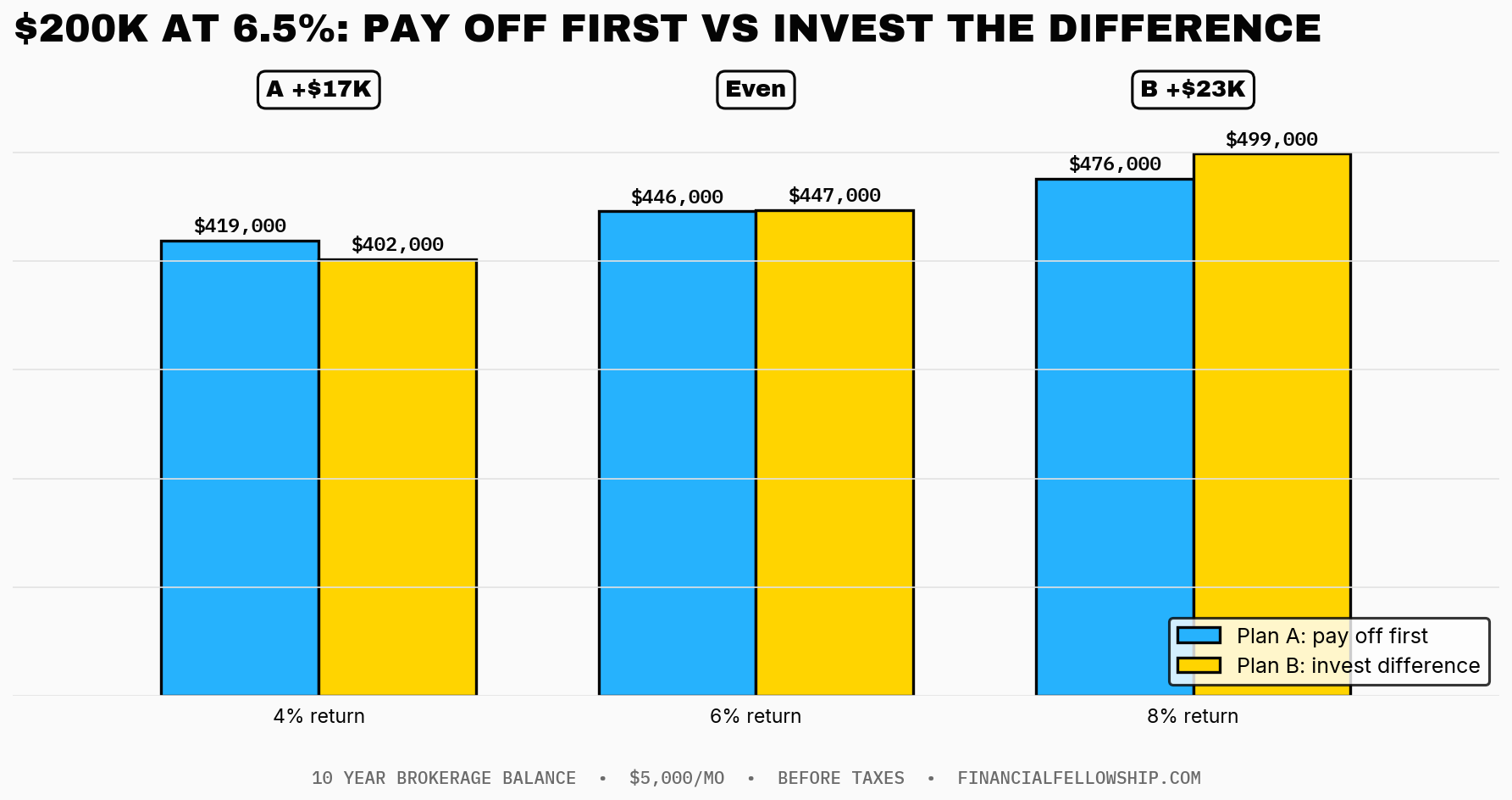
At year 10, both plans are debt free. The brokerage balances compare like this, before taxes.
| Annual investment return | Plan A (pay off first) | Plan B (invest the difference) | Winner |
|---|---|---|---|
| 4 percent | about $419,000 | about $402,000 | Plan A by about $17,000 |
| 6 percent | about $446,000 | about $447,000 | About even |
| 8 percent | about $476,000 | about $499,000 | Plan B by about $23,000 |
These returns are assumptions for illustration, not forecasts. Two things jump out. The gap is small at any return. And the only case where investing wins is the one where markets hand you 8 percent a year for a decade, before paying taxes on that brokerage account, which shrinks Plan B's edge further.
So at a 6.5 percent loan rate, aggressive payoff comes out about even or ahead in most of the outcomes, with zero risk. At 3 percent, the answer flips, and investing wins in most scenarios.
Doesn't paying the loans off early leave me with nothing invested?
It leaves you with less in the brokerage account for a few years, but your retirement accounts are still getting filled every year in this plan. And the behavioral side counts. Once the payment is gone, that same $5,000 a month tends to flow straight into investing, because you're already used to living without it. Try to give every debt a five year or less end date. That habit is worth more than squeezing out the last percent of expected return.
Framework box: where the next dollar goes
- Employer match, in full.
- One month of reserves, sized at your current lifestyle.
- Every credit card to zero, whatever the rate.
- Disability and term coverage in place.
- The student loan plan, running in parallel.
- Backdoor Roth IRA.
- Retirement accounts maxed.
- Reserves to three months.
- Debt above 7 percent.
- Finish the reserve: six months of expenses on W2 income, twelve months on 1099 income.
- Taxable investing.
Rule of thumb: debt above 7 percent gets extinguished at its step, after the retirement accounts are maxed and the reserve holds three months. Below 7 percent, the money keeps flowing down the waterfall.
On PSLF, skip step 9 for the federal loans. Every extra dollar you prepay is a dollar that would have been forgiven.
Follow up questions
Should I keep a bigger emergency fund before prepaying loans?
Build it in stages. One month of expenses first, at the start. Three months total once the retirement accounts are maxed. Debt above 7 percent goes next. Then the fund gets finished, six months of expenses on W2 income or twelve months on 1099 income, before taxable investing. Only the first month comes ahead of zero cards and coverage, and none of it jumps the match. A prepaid loan can't be borrowed back if you lose a job or face a disability waiting period.
Should I refinance before paying aggressively?
If you're not pursuing PSLF, a lower rate makes aggressive payoff cheaper, and a shorter term forces the habit. Once you refinance federal loans into a private loan, you can't go back to PSLF or income driven plans, so settle the PSLF question first.
Does a 529 or a house down payment come before the loans?
The date you need the money decides it. A goal less than five years out gets its own savings. A 529 for a newborn can usually wait until the high rate debt is gone.
Sources
- Internal Revenue Service, 2026 401(k) and IRA contribution limits. 401(k) and Profit-Sharing Plan Contribution Limits (accessed September 30, 2026)
- Internal Revenue Service, Topic No. 456, Student Loan Interest Deduction. Topic No. 456 (accessed September 30, 2026)
Published September 30, 2026. Last reviewed October 11, 2026.
Ryan Inman spent 10 years as a financial advisor to physicians, hosted the Financial Residency podcast, and founded Financial Fellowship to teach physicians the money mechanics of a medical career.
Have a money question from your own training or practice? Submit it at financialfellowship.com/submit. Real questions get real answers.
Takeaways
- Retirement accounts come before extra payments on debt under 7 percent. Unused 401(k) and IRA space is gone forever each year.
- Capture the full employer match before anything else.
- Rule of thumb: debt above 7 percent gets extinguished at its step, after the retirement accounts are maxed and the reserve holds three months.
- Paying a 6.5 percent loan is like earning 6.5 percent risk free and tax free.
- Credit cards go to zero early in the order, right after the match and one month of reserves, whatever the rate.
Have a money question we have not answered?
If you have a question about a decision you are about to make, ask it here.
Ask your questionMore reading

How do I compare a locums rate to my W2 salary with benefits?
Compare per day worked, not per year: price every W2 benefit in dollars, then divide by days worked. A locums rate usually needs to beat the W2 daily figure by 15 to 35 percent to break even.

What is tail coverage, and who pays for it when I leave?
Tail coverage keeps a claims made malpractice policy covering you for claims filed after you leave. Your contract decides who pays, and it is usually priced as a multiple of your annual premium.

I bought whole life insurance after residency. Should I keep it or surrender it?
Ignore what you have already paid. Get an in force illustration, price the return on future premiums from today's surrender value, and exit once replacement term coverage is in force if that return is low.
If you have a question about a decision you are about to make, ask it here
Ask your question